Blog image

Build Beyond Chat—
Make AI Do Sh*t.

No fluff. Just deep dives into tool-calling and agent auth to make your AI actually useful.

Icon
Search icon
PRODUCT RELEASE

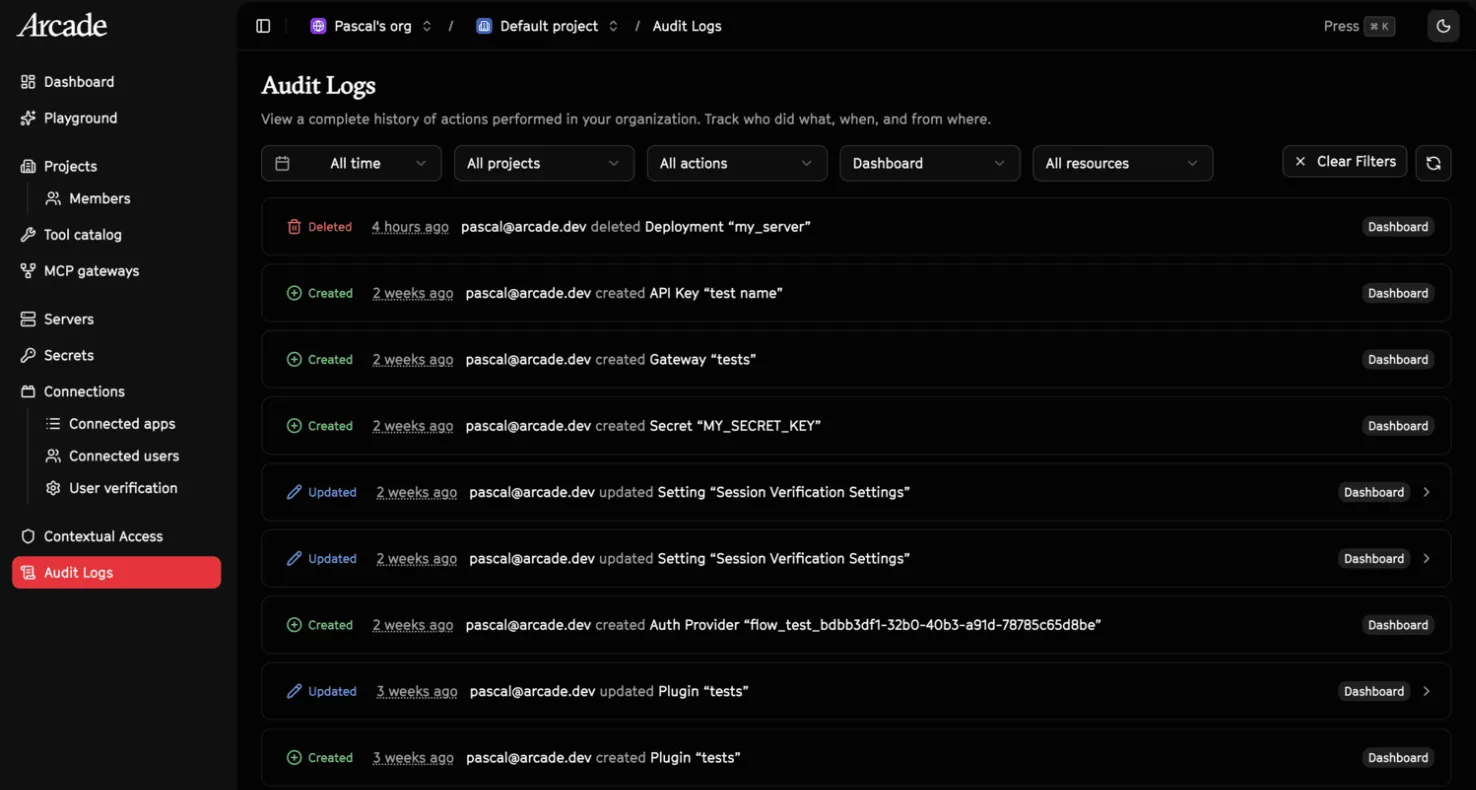
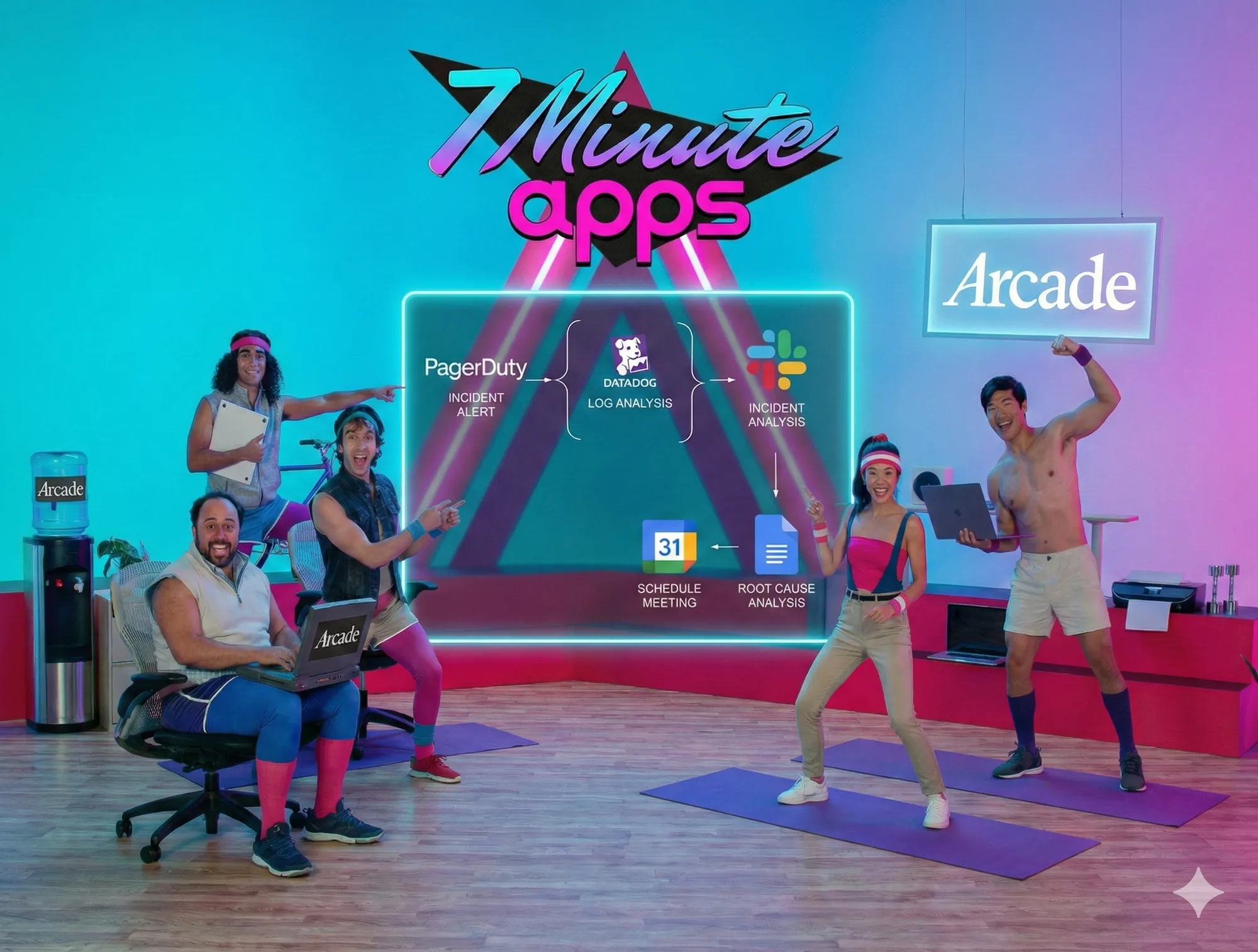
Every Action, Accounted For: Using Audit Logs on Arcade

Arcade captures every administrative action across your AI agent runtime automatically — who did it, how, what changed, and when. Audit logs are on by default, with a filterable dashboard and a REST API.

MCP

Too many tools: What GitHub learned about building for agents from their MCP Server launch

Sam Morrow and his colleagues started building GitHub's MCP server as an internal side project. One year and a bumpy start later, it's the most-used remote MCP server in the world. Sam has much to teach us about scaling tool design, auth, and what agents actually need from an enterprise server.


MCP

MCP Toolkit Benchmark: Arcade vs Composio, A 100x Token Difference

We benchmarked two Attio MCP toolkits across 8 CRM queries. Arcade consumed 7,426 tokens. Composio consumed 747,083. Here's the full breakdown of what caused the gap and what it means at scale.

MCP

Building High-Quality MCP Tools with Arcade Evals

Tool definitions are not function signatures. They are menu items an LLM reads to decide what to call and how to fill the arguments. This post covers what separates good tool definitions from bad ones, with before/after examples and a practical checklist.

MCP

Everything Is a Test: How to Evaluate MCP Tools for Reliable AI Agents

Tool quality directly affects agent reliability. Arcade Evals lets you test MCP tool definitions against LLM behavior in simulated conversations, scoring whether the model selects the right tool and populates arguments correctly, before you deploy to production.

Rays decoration
MCP

AX Is the New DX: How ElevenLabs Teaches Agents to Build with Skills, Tools, and Apps

Paul Asjes has been building SDKs at Stripe and WorkOS for years. Now, as DevX Lead at ElevenLabs, he's rethinking what developer education means when the learner is a developer's agent.

PRODUCT RELEASE

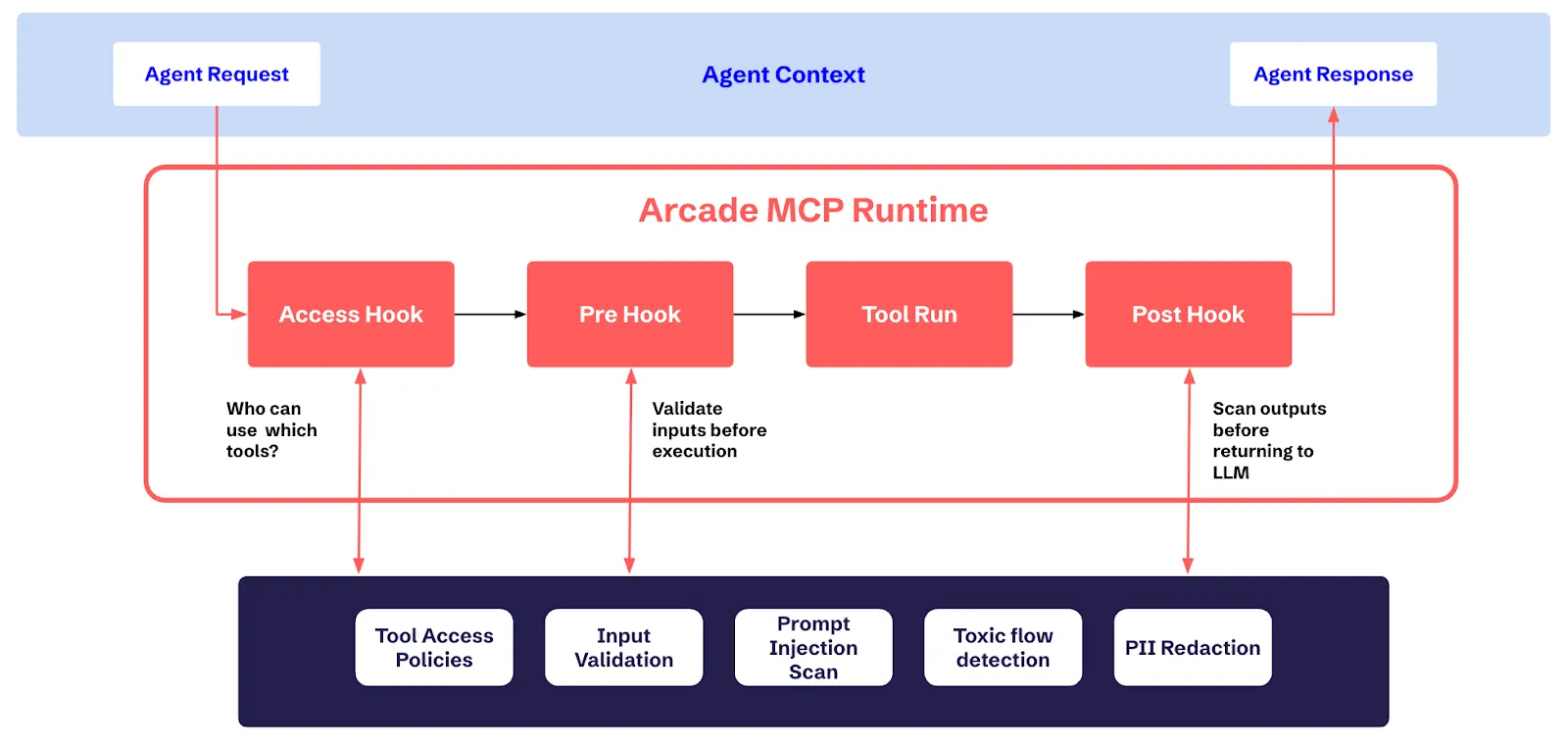
Introducing Contextual Access: The Third Layer of AI Agent Security

TL;DR: Arcade protects AI agent tool execution with delegated identity, scoped tool access, and governance. Today we're extending that security model with Contextual Access: runtime hooks that let you inject your own security, compliance, and filtering logic directly into the tool execution pipeline across three hook points, via any webhook on every tool call.

Rays decoration

WebMCP: The Web Standard That Makes Every Website a Tool for Agents

Alex Nahas built MCP inside a browser at Amazon. Now Microsoft and Google are turning it into a W3C standard. This article is adapted from Alex's interview in our video series MCP MVP. Episode 1 features Alex Nahas, creator of MCP-B and a driving force behind the WebMCP specification.

PRODUCT RELEASE

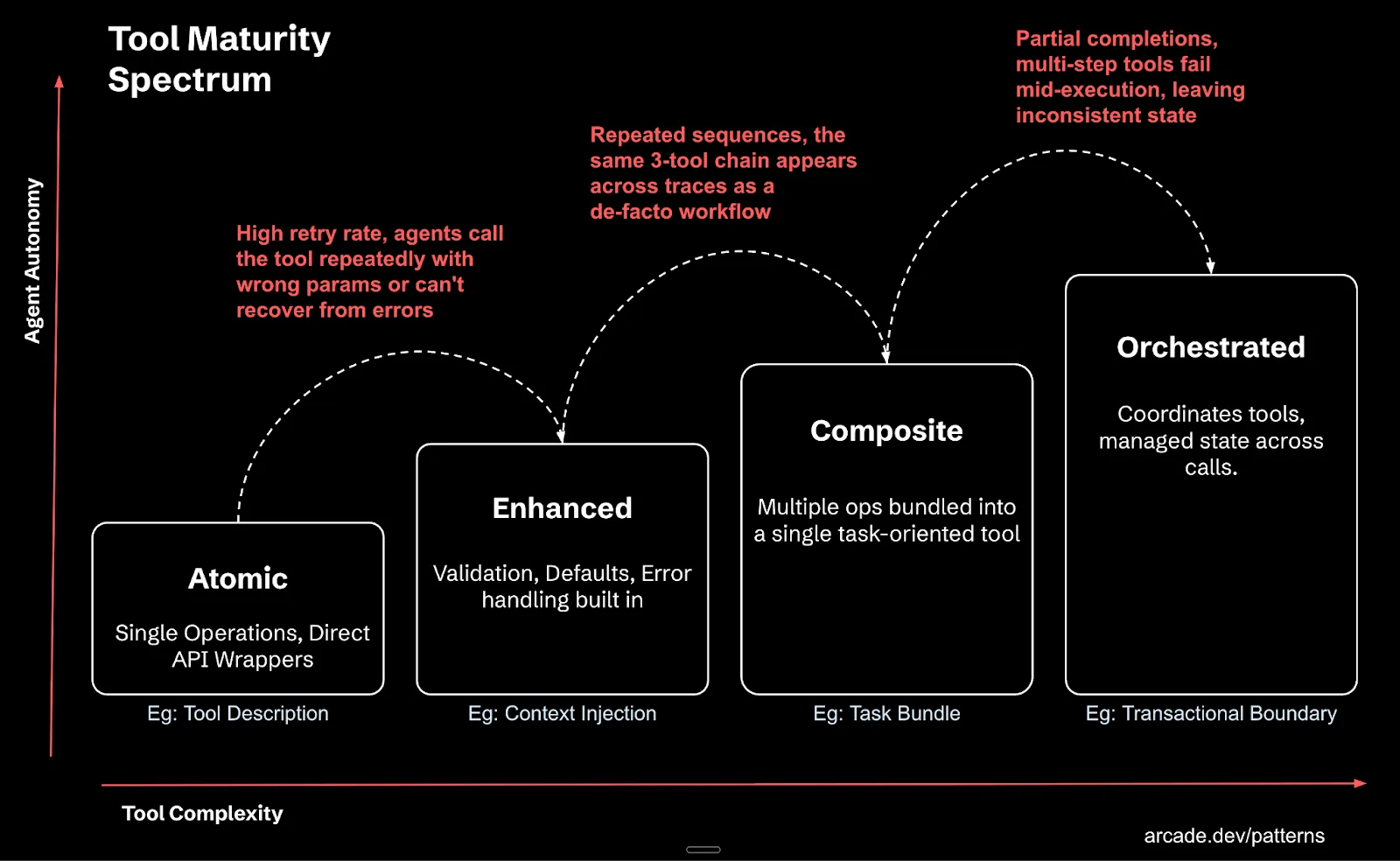
Patterns for Agentic Tools: Your agents are only as good as your tools.

The Moment Every few years, a new pattern language emerges that changes how we build software. In 1994, the Gang of Four gave us Design Patterns. In 2003, Hohpe and Woolf gave us Enterprise Integration Patterns. Since then: Microservices Patterns, Cloud Patterns, and now Agent Patterns. But there's a gap. Agents can chat and reason on their own - but they can't ‘act’ without tools. Standards like MCP have unlocked how agents discover and call tools. The protocol layer is solved. What's missin

TUTORIALS

OpenClaw can do a lot, but it shouldn't have access to your tokens

OpenClaw (a.k.a. Moltbot, a.k.a. ClawdBot) went viral and became one of the most popular agentic harnesses in a matter of days. Peter Steinberger had a successful exit from PSPDFKit, and felt empty until the undeniable potential of AI sparked renewed motivation to build. And he's doing it it non-stop. OpenClaw approaches the idea of an Personal AI agent as a harness that communicates with you (or multiple users) in any of the supported channels in multiple sessions connected to the underlying

THOUGHT LEADERSHIP

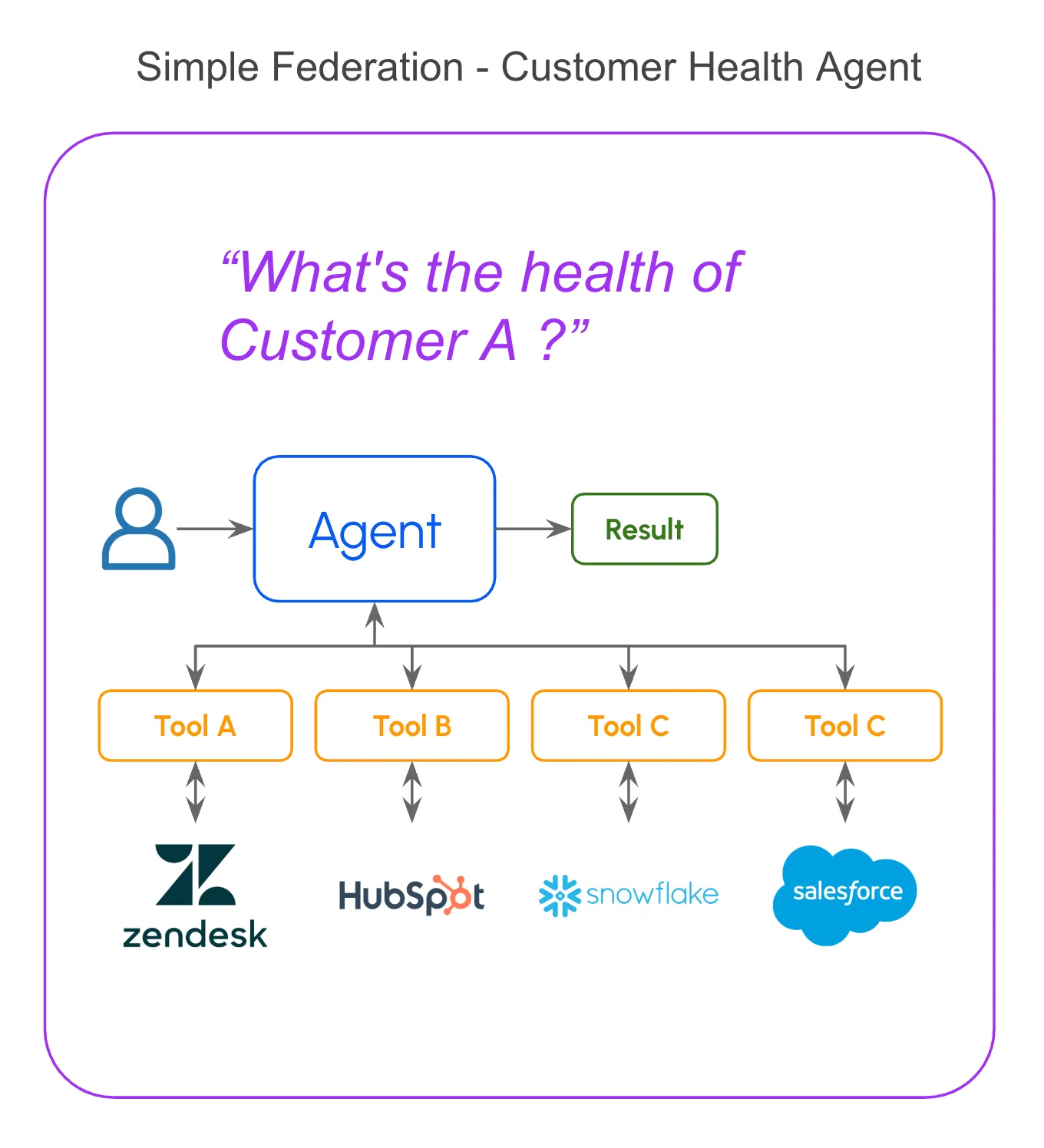
Federation Over Embeddings: Let AI Agents Query Data Where It Lives

Before building vector infrastructure, consider federation: AI agents with tool access to your existing systems. For most enterprise use cases, that's all you need. Someone told you to pivot to AI. Add an AI layer. “We need to be AI-first.” Fair enough. So you start thinking: what does AI need? Data. Obviously. So the playbook writes itself: collect data in a central place, set up a vector database, do some chunking, build a RAG pipeline, maybe fine-tune a model. Then query it. Ship the chatb

Rays decoration
MCP

The MCP Gateway Pattern: scaling agentic integrations without tool sprawl

MCP makes it easy to go from “agent” to “agent that takes action.” The trap is that success compounds: every new system becomes a new server, every team ships “just one more tool,” and soon your integration surface is too large to reason about, too inconsistent to secure, and too messy to operate. Meanwhile, the model gets blamed for failure modes that are actually integration design problems. Tool definitions balloon. Selection accuracy drops. Context gets eaten before anyone types a prompt. A

How Arcade Proactively Addressed The First Major Identity Vulnerability in Agentic AI

While building an AI demo has become trivially easy, production-grade deployments in enterprises have been stifled by performance issues, costs, and security vulnerabilities that their teams have been warning about. Today, we're addressing one of those vulnerabilities head-on. A new class of identity attack Security researchers at The Chinese University of Hong Kong recently identified new variants of COAT (Cross-app OAuth Account Takeover), an identity phishing attack targeting agentic AI a

TUTORIALS

New Year, New Agents to Make You More Productive

Most conversations about AI agents still start the same way: models, prompts, frameworks, followed by an incredible looking demo. Then someone asks, “Okay… when can it ship to production?” That’s where things get a little awkward. The naked truth in the fading demo afterglow is that agents are apps. Which means they need identity, permissions, real integrations, and a way to behave predictably when something goes sideways. Without these components, any agent can dazzle a boardroom, but it won

THOUGHT LEADERSHIP

5 Takeaways from the 2026 State of AI Agents Report

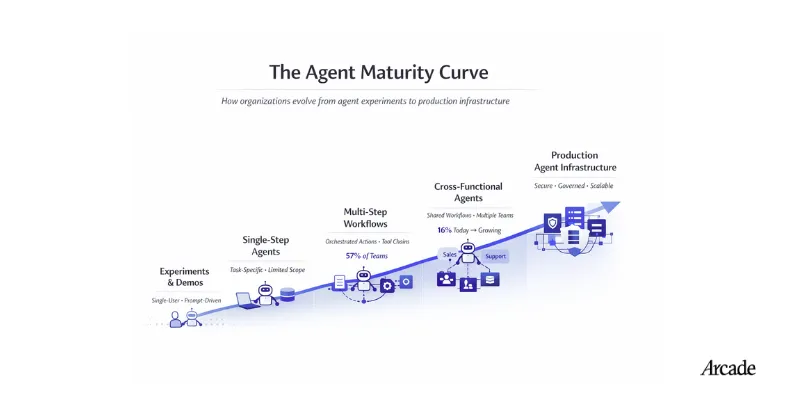
AI agents have moved quickly from experimentation to real-world deployment. Over the past year, organizations have gone from asking whether agents work to figuring out how to deploy enterprise AI agents reliably at scale. The 2026 State of AI Agents Report from the Claude team captures this shift clearly. Drawing on insights from teams building with modern LLM agents—including those powered by models from providers like Anthropic—the report offers a grounded view of how agentic systems are bein

THOUGHT LEADERSHIP

What It’s Actually Like to Use Docker Sandboxes with Claude Code

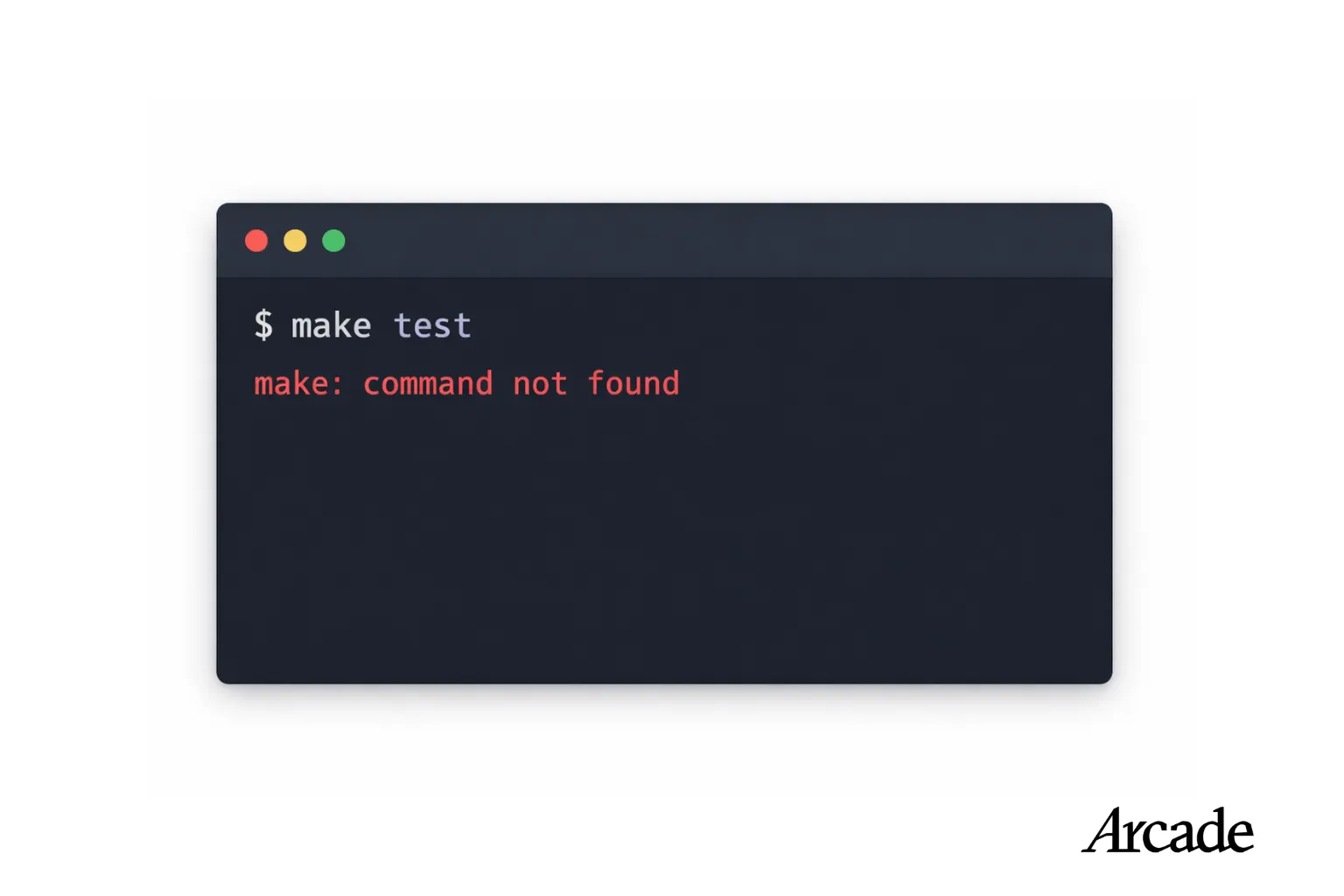
We spend a lot of time thinking about how to safely give AI agents access to real systems. Some of that is personal curiosity, and some of it comes from the work we do at Arcade building agent infrastructure—especially the parts that tend to break once you move past toy demos. So when Docker released Docker Sandboxes, which let AI coding agents run inside an isolated container instead of directly on your laptop, we wanted to try it for real. Not as a demo, but on an actual codebase, doing the k

THOUGHT LEADERSHIP

Docker Sandboxes Are a Meaningful Step Toward Safer Coding Agents — Here’s What Still Matters

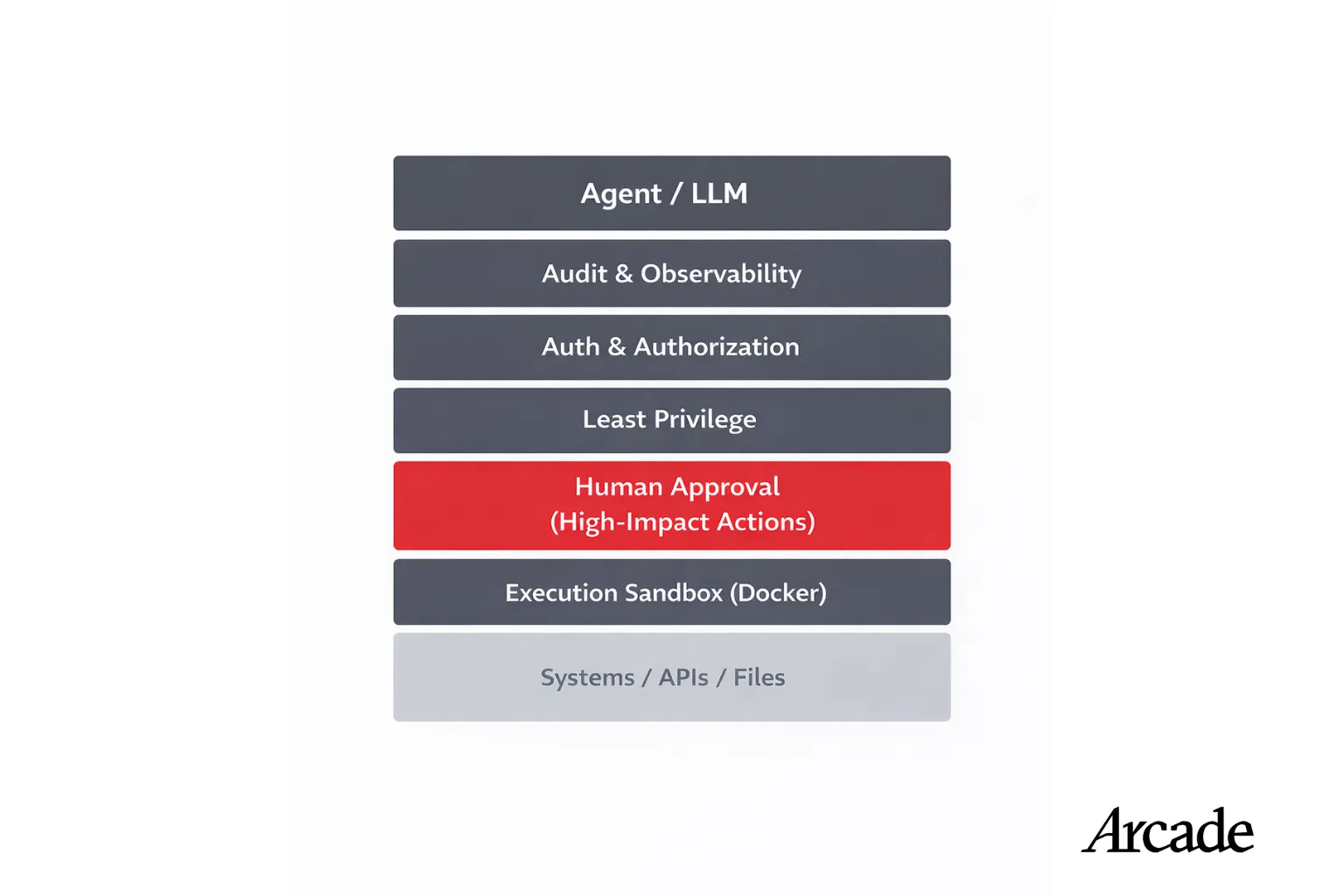
Docker recently announced Docker Sandboxes, a lightweight, containerized environment designed to let coding agents work with your project files without exposing your entire machine. It’s a thoughtful addition to the ecosystem and a clear sign that agent tooling is maturing. Sandboxing helps solve an important problem: agents need room to operate. They install packages, run code, and modify files — and giving them that freedom without exposing your laptop makes everyone sleep a little better. B

THOUGHT LEADERSHIP

Build on the Bubble: Why foundation model instability is the best thing that ever happened to enterprise AI

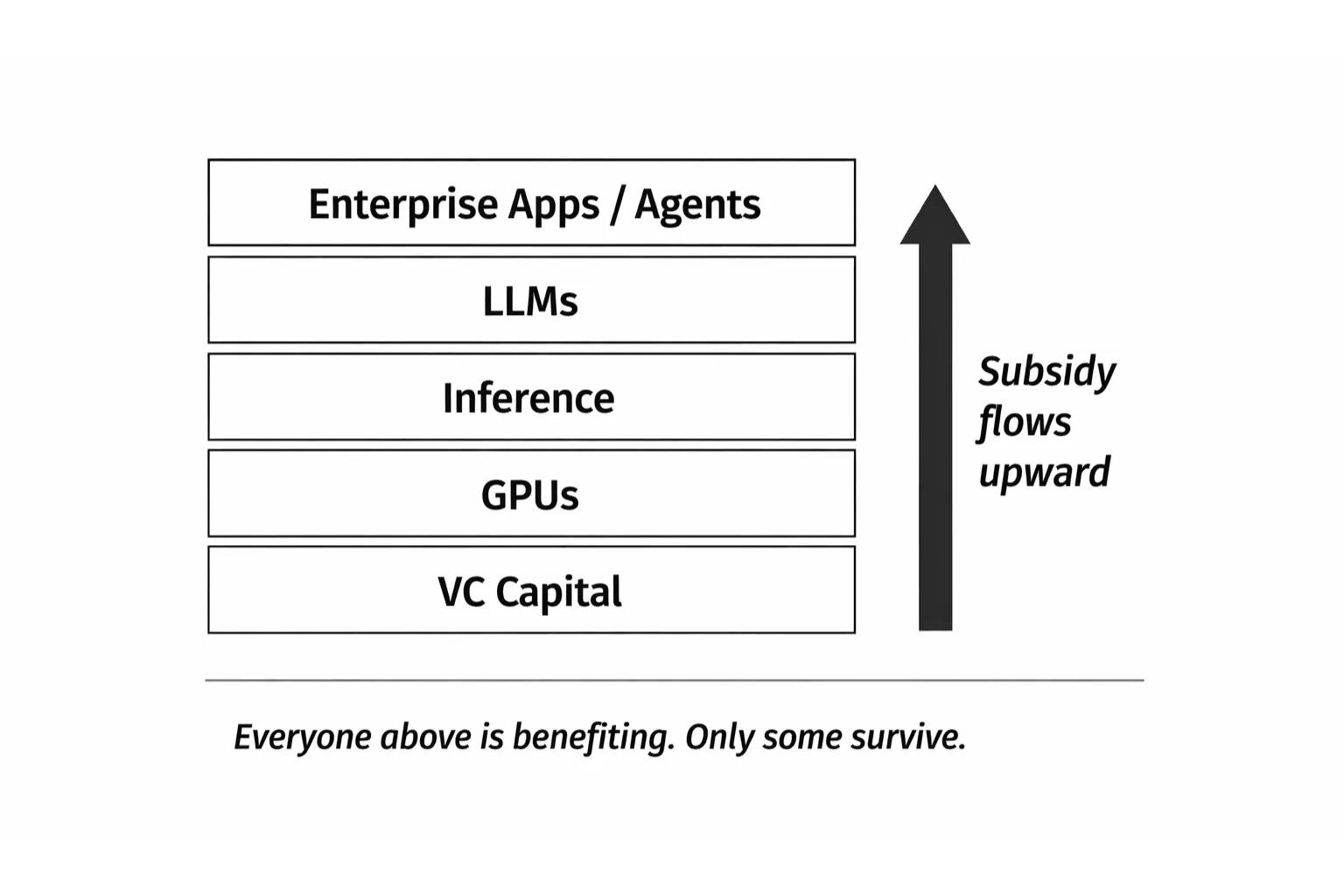
Right now, somewhere in San Francisco, a foundation model company is losing money serving your API call. OpenAI spent $8.67 billion on inference in the first nine months of 2025—nearly double their revenue for the same period. Sam Altman publicly admitted they lose money on $200-per-month ChatGPT Pro subscriptions. Anthropic burns 70% of every dollar they bring in. These companies are pricing their products below cost, subsidized by the largest concentration of venture capital in technology his

COMPANY NEWS

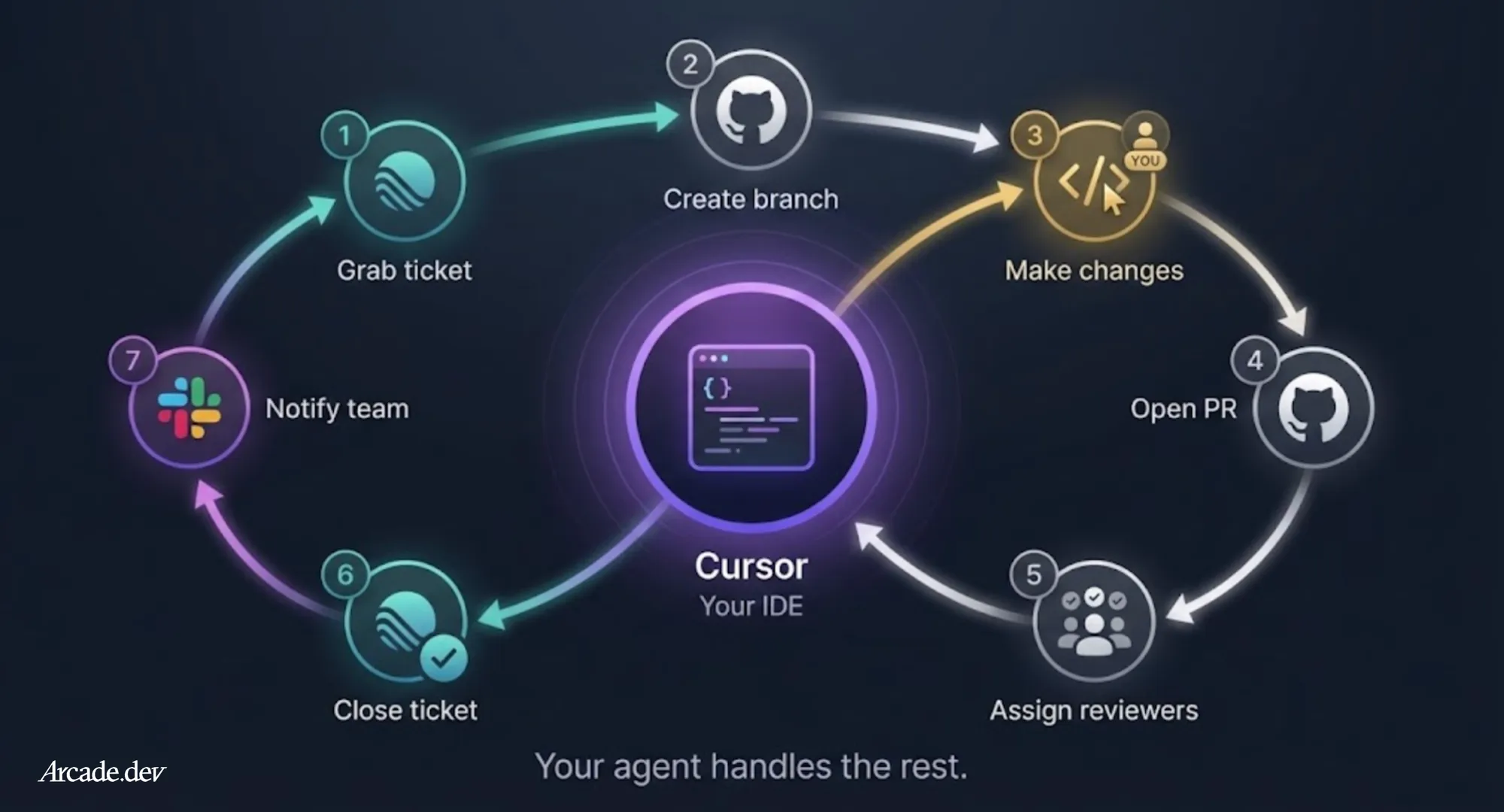
Your MCP Client Just Got Superpowers: Arcade Tools are now in Cursor, VS Code, and more

If you've been using Cursor, Claude Desktop*, VS Code, or any MCP-compatible client, you've probably experienced the same frustration: your agent is brilliant at reasoning through workflows, but the moment it needs to actually do something across your tools, you're back to juggling configurations for each individual tool, debugging auth flows, and troubleshooting why the setup that worked yesterday doesn't work today. Those days are over. With the launch of Arcade MCP Gateways, your MCP client

Rays decoration
THOUGHT LEADERSHIP

Agent Skills vs Tools: What Actually Matters

The agent ecosystem has a terminology problem that masks a real architectural choice. "Tools" and "skills" get used interchangeably in marketing decks and conference talks, but they represent fundamentally different approaches to extending agent capabilities. Understanding this distinction is the difference between building agents that work in demos versus agents that work in production. But here's the uncomfortable truth that gets lost in the semantic debates: from the agent's perspective, it'

Rays decoration
THOUGHT LEADERSHIP

We Threw 4,000 Tools at Anthropic's New Tool Search. Here's What Happened.

TL;DR: Anthropic's new Tool Search is a step in the right direction-but if you're running 4,000+ tools across multiple services, it might not be ready for prime time. The promise Anthropic's Tool Search promises to let Claude "access thousands of tools without consuming its context window." Music to our ears. At Arcade, we maintain thousands of agent-optimized tools across Gmail, Slack, GitHub, HubSpot, Salesforce, and dozens more platforms. If anyone was going to stress-test this feature, it

Rays decoration
THOUGHT LEADERSHIP

What does Anthropic's Tool Search for Claude mean for you?

I was recently in Amsterdam meeting with some of the largest enterprises, and they all raised the same challenge: how to give AI agents access to more tools without everything falling apart?  The issue is that as soon as they hit 20-30 tools, token costs became untenable and selection accuracy plummeted. The pain has been so acute that many teams have been attempting (unsuccessfully) to build their own workarounds with RAG pipelines, only to hit performance walls.  That's why I'm excited about

Rays decoration
THOUGHT LEADERSHIP

Let's talk about LLM tools: simple additions with massive results

It’s popular to test Large Language Models (LLMs) by asking them to solve difficult puzzles, like multiplying huge numbers. These tests are interesting research benchmarks, but they can miss something important: real-world usefulness. When was the last time you asked a coworker to multiply a 20-digit number in their head, without a calculator? Real-world usefulness is not always well-represented by artificial benchmarks. Throughout history, humans have invented tools to boost their abilities: c

Rays decoration
THOUGHT LEADERSHIP

30 Software Scaling in AI Stats: Market Growth, Enterprise Adoption, and Infrastructure Metrics

Comprehensive analysis of AI software scaling trends, infrastructure requirements, and deployment success metrics across enterprise and cloud environments The gap between AI adoption and scaled implementation defines the current state of enterprise AI, with 88% use AI regularly but nearly two-thirds of respondents say their organizations have not yet begun scaling AI across the enterprise. As the global AI market accelerates toward $3.68 trillion by 2034, organizations face mounting pressure t

Rays decoration
THOUGHT LEADERSHIP

43 AI Workflow Automation Metrics: ROI Benchmarks, Adoption Rates, and Performance Statistics for 2025

Data-driven analysis of workflow automation effectiveness, enterprise implementation patterns, and measurable business outcomes across industries The gap between AI adoption and successful implementation defines the current automation landscape. While 88% of enterprises report regular AI use, only a fraction achieve measurable ROI—creating massive opportunity for organizations that solve the implementation challenge. The workflow automation market, valued at USD 23.77 billion in 2025, rewards

Rays decoration
THOUGHT LEADERSHIP

30 Agentic Framework Adoption Trends: Enterprise Investment, Market Growth, and Implementation Success Rates

Analysis of agentic AI adoption patterns, ROI benchmarks, and enterprise deployment statistics shaping the future of autonomous AI systems The shift from conversational AI to autonomous agents capable of executing real-world tasks represents a fundamental transformation in enterprise technology. With 79% of organizations now reporting AI agent adoption and the market projected to reach $199.05 billion by 2034, agentic frameworks have moved from experimental curiosity to business necessity. Arc

Rays decoration
THOUGHT LEADERSHIP

Enterprise MCP Guide For Supply Chain & Procurement: Use Cases, Best Practices, and Trends

Model Context Protocol (MCP) has become the missing link between AI assistants that chat and AI agents that execute. For supply chain and procurement leaders, this shift matters because Arcade's MCP runtime and AI tool-calling platform transforms MCP from a promising protocol into a production-ready MCP runtime for multi-user authorization across tools—enabling agents to securely act across ERPs, supplier portals, and logistics systems without exposing credentials to language models. Arcade's MC

Rays decoration
THOUGHT LEADERSHIP

Enterprise MCP Guide For Consumer Packaged Goods (CPG): Use Cases, Best Practices, and Trends

When Unilever connected weather forecasts to their ice cream AI agent, sales jumped 30% in key markets. That single integration—linking external weather data to demand forecasting—demonstrates the power of Model Context Protocol (MCP) for CPG operations. Unlike traditional APIs that require custom integrations for every AI application, standardized MCP runtime enables AI agents to securely access supply chain systems, consumer insights platforms, and retailer data through governed, multi-user au

Rays decoration
THOUGHT LEADERSHIP

Enterprise MCP Guide For Retail & eCommerce: Use Cases, Best Practices, and Trends

Model Context Protocol (MCP) has emerged as the standardized framework enabling AI agents to securely interact with enterprise retail systems—from inventory management to customer service platforms. As 78% of companies already integrate AI into operations, retail leaders face a critical decision: build custom integrations for every platform or adopt the infrastructure that treats MCP as the "USB-C for AI." Arcade's MCP runtime and AI tool-calling platform solves the core challenge holding back a

Rays decoration
THOUGHT LEADERSHIP

Enterprise MCP Guide For Life Sciences Compliance & Quality: Use Cases, Best Practices, and Trends

Life sciences organizations face a critical infrastructure gap: AI agents can't securely access the fragmented, domain-specific data trapped across quality management systems, LIMS, clinical trial databases, and regulatory platforms. Building custom integrations for every AI-to-database connection creates a $300K-$900K bottleneck that prevents pharmaceutical companies from deploying AI at scale. Model Context Protocol (MCP) transforms this challenge from 30 fragile custom integrations to 13 stan

Rays decoration
THOUGHT LEADERSHIP

Using LangChain and Arcade.dev to Build AI Agents For Retail & eCommerce: Top 3 Use Cases

Key Takeaways * Retail AI agents face a production deployment crisis: While 51% of organizations already have AI agents in production, 70% of e-commerce carts are abandoned and traditional chatbots can't complete purchases — Arcade.dev's MCP runtime solves the multi-user authorization gap blocking retail agents from taking real action * LangChain dominates agent orchestration but lacks secure tool execution: LangChain has emerged as the leading framework for building AI agents, yet without A

Rays decoration
THOUGHT LEADERSHIP

Using LangChain and Arcade.dev to Build AI Agents For Insurance (P&C/Life): Top 3 Use Cases

Key Takeaways * Insurance AI agents unlock $60-80 million in cost savings but fail at multi-user authorization: Property & casualty insurers report $60-80 million annually in cost savings from AI automation, yet agents stall at production because they can't securely act on behalf of thousands of independent agents, claims adjusters, and underwriters — Arcade.dev's MCP runtime solves this authorization gap * LangChain orchestrates workflows while Arcade enables secure action: LangChain provid

Rays decoration
THOUGHT LEADERSHIP

Using LangChain and Arcade.dev to Build AI Agents For FinTech & Payments: Top 3 Use Cases

Key Takeaways * Multi-user authorization remains the primary barrier blocking production AI in financial services: Less than 30% of AI projects reach production, with 70% never reach production, largely due to security reviews — Arcade.dev solves this as the MCP runtime that enables and governs multi-user authorization across banking APIs, payment processors, and CRM platforms * LangChain provides orchestration, Arcade enables secure execution: LangChain's agent framework handles reasoning a

Rays decoration
THOUGHT LEADERSHIP

Using LangChain and Arcade.dev to Build AI Agents For Asset & Wealth Management: Top 3 Use Cases

Key Takeaways * The AI agents market in financial services will grow from $490.2 million in 2024 to $4.48 billion by 2030, yet production deployment stalls at authorization: AI agents can help wealth advisors reclaim up to 75% of the time they currently spend on routine tasks like portfolio reporting, compliance alerts, and client onboarding — tasks agents can automate if they can securely act across Gmail, CRMs, and custodian platforms. Arcade.dev's MCP runtime solves the multi-user authoriz

Rays decoration
THOUGHT LEADERSHIP

26 Custom SDK Implementation with AI Statistics: Market Growth, Developer Adoption, and ROI Metrics

Data-driven analysis of custom AI SDK market expansion, implementation success rates, and the infrastructure powering enterprise tool-calling applications Custom SDK implementations have become the backbone of AI-powered applications, with the agentic AI developer ecosystem projected to grow from $6.96 billion in 2025 to $42.56 billion by 2030. This explosive growth reflects enterprise demand for governed tool execution that goes beyond basic API integrations. Arcade.dev addresses this directl

Rays decoration
THOUGHT LEADERSHIP

Enterprise MCP Guide For Clinical Research Organizations (CROs): Use Cases, Best Practices, and Trends

Clinical Research Organizations face a critical infrastructure challenge: connecting AI systems to clinical trial data, regulatory platforms, and research databases without building custom integrations for every single connection. Model Context Protocol (MCP), introduced by Anthropic in late 2024, provides the standardized framework CROs need—but only when paired with an MCP runtime and production-grade multi-user authorization platform like Arcade.dev that handles the complex token and secret m

Rays decoration
THOUGHT LEADERSHIP

Enterprise MCP Guide For Medical Devices: Use Cases, Best Practices, and Trends

Medical device manufacturers face a critical challenge: connecting AI agents to regulated systems without breaking HIPAA, FDA, or GxP compliance. Model Context Protocol (MCP) offers a standardized solution—but only when implemented with enterprise-grade security and multi-user authorization. Arcade's MCP runtime provides the MCP-compatible infrastructure that enables medical device companies to deploy AI agents with production-grade multi-user authorization, token and secret management, and the

Rays decoration
THOUGHT LEADERSHIP

Enterprise MCP Guide For Biotech: Use Cases, Best Practices, and Trends

Your scientists spend significant time searching PubMed, patent databases, and internal documentation manually. Your AI agents can't access proprietary compound data. Every new AI integration requires weeks of custom development. Model Context Protocol (MCP) solves all three challenges by giving AI agents secure, governed access to the specialized data sources biotech R&D relies on—from literature databases to LIMS systems—through one standardized protocol instead of dozens of fragile custom con

Rays decoration
THOUGHT LEADERSHIP

Enterprise MCP Guide For Pharmaceuticals: Use Cases, Best Practices, and Trends

Pharmaceutical enterprises face a critical integration challenge: AI systems that could accelerate drug discovery, streamline regulatory compliance, and optimize clinical trials remain disconnected from the fragmented, domain-specific data sources they need to deliver value. Model Context Protocol (MCP), introduced by Anthropic in late 2024, solves this by providing a universal integration standard that enables AI agents to securely connect to pharmaceutical systems while maintaining GxP complia

Rays decoration
THOUGHT LEADERSHIP

Enterprise MCP Guide For Health Insurers & Payers: Use Cases, Best Practices, and Trends

Health insurers face mounting pressure to automate complex workflows across claims processing, provider credentialing, and member services—all while maintaining HIPAA compliance and managing multi-user authorization at scale. With 46% of physicians receiving any value-based payments and healthcare systems struggling to transmit resources to frontline practices, payers need infrastructure that lets AI agents actually take action across fragmented, domain specific systems. Arcade's MCP runtime and

Rays decoration
THOUGHT LEADERSHIP

Enterprise MCP Guide For Healthcare Providers: Use Cases, Best Practices, and Trends

Healthcare leaders recognize automation's urgency: 92% cite automation as critical for addressing staff shortages. Yet only 30% of AI pilots reach production due to integration and multi-user authorization barriers. Model Context Protocol (MCP) solves the M×N integration problem blocking deployment at scale. Your Electronic Health Record has an API. Your data warehouse has an API. Your billing system has an API. But your AI agents can't securely act on behalf of multiple users across these syste

Rays decoration
THOUGHT LEADERSHIP

Enterprise MCP Guide For Accounting & Audit Firms: Use Cases, Best Practices, and Trends

Your AI assistant just queried QuickBooks for a client's transaction history, pulled audit evidence from Vanta, and flagged three suspicious invoices—all in under five minutes. But can you prove to regulators exactly which data it accessed, who authorized those actions, and that sensitive financial information never leaked to the underlying AI model? This is the multi-user authorization challenge that Arcade's MCP runtime and AI tool-calling platform solves, transforming AI from a compliance ris

Rays decoration
THOUGHT LEADERSHIP

Enterprise MCP Guide For Wealth & Asset Management: Use Cases, Best Practices, and Trends

Wealth managers spend 40% of their time on data drudgery—compiling reports, toggling between systems, answering routine client questions. Meanwhile, compliance teams sift through 220 regulatory alerts daily. This productivity drain costs firms millions in lost advisory hours while exposing them to missed compliance deadlines. Arcade's AI tool-calling platform solves this challenge through Model Context Protocol (MCP), enabling AI agents to securely act on behalf of users with delegated permissio

Rays decoration

MCP Grows Up: The Spec That Makes AI Agents Real

You tell your AI agent: “Send that report to my manager.” It drafts the perfect message — and then stops. The problem isn’t intelligence; it’s identity. It can’t press “send,” because your email — like every good enterprise system — lives behind an auth wall. That’s the invisible barrier keeping AI from doing real work: agents can’t safely act on behalf of their users. That small roadblock points to a much bigger one. AI agents can reason, plan, and communicate — but they’ve been locked out

Rays decoration
THOUGHT LEADERSHIP

Enterprise MCP Guide For Retail Banking & Payments: Use Cases, Best Practices, and Trends

The global payments industry processes $2.0 quadrillion in value flows annually, generating $2.5 trillion in revenue. Yet despite decades of digital transformation investment, critical banking operations,anti-money laundering investigation, KYC onboarding, payment reconciliation,remain largely manual. Model Context Protocol (MCP) represents the infrastructure breakthrough that enables financial institutions to move beyond chatbot pilots to production-grade AI agents that take multi-user authoriz

Rays decoration
THOUGHT LEADERSHIP

Enterprise MCP Guide For Capital Markets & Trading: Use Cases, Best Practices, and Trends

Capital markets technology leaders face a critical infrastructure challenge: scattered AI pilots, disconnected integrations, and fragmented, domain-specific systems that turn engineers into human APIs manually stitching together trading platforms, market data feeds, and risk management tools. The Model Context Protocol (MCP) represents a fundamental shift from this costly one-off integration approach to a universal standardization layer that acts as the backbone for AI-native financial enterpris

Rays decoration
THOUGHT LEADERSHIP

Enterprise MCP Guide For InsurTech: Use Cases, Best Practices, and Trends

The insurance industry faces a pivotal transformation moment. Model Context Protocol (MCP) has moved from experimental technology to production infrastructure, with 16,000+ active servers deployed across enterprises and millions of weekly SDK downloads. For InsurTech leaders, the question is no longer whether to adopt MCP, but how to implement it securely and effectively. Arcade's platform provides the MCP runtime for secure, multi-user authorization so AI agents can act on behalf of users acros

Rays decoration
THOUGHT LEADERSHIP

Enterprise MCP Guide For FinTech & Financial Institutions: Use Cases, Best Practices, and Trends

Model Context Protocol has emerged as the missing infrastructure layer that enables AI agents to act securely across financial systems. For fintech leaders navigating the $1 trillion AI opportunity in banking, MCP solves a critical problem: how to grant AI systems the precise, delegated permissions needed to execute real transactions without exposing tokens or credentials to language models. Arcade's MCP runtime provides the production-grade authorization layer that transforms AI pilots into sec

Rays decoration
THOUGHT LEADERSHIP

Using LangChain and Arcade.dev to Build AI Agents For Financial Services (Banking): Top 3 Use Cases

Key Takeaways * Banking AI agents face a multi-user authorization bottleneck, not a chatbot problem: While 51% of organizations already have AI agents in production, financial institutions struggle with secure multi-user authorization,Arcade.dev's MCP runtime solves this by enabling delegated user permissions and scoped access across Gmail, Slack, Salesforce, and core banking systems * LangChain dominates orchestration but requires Arcade for production banking: LangChain's 99K+ GitHub stars

Rays decoration
THOUGHT LEADERSHIP

Using LangChain and Arcade.dev to Build AI Agents For Health Insurance (Payers): Top 3 Use Cases

Key Takeaways * $18 billion claims processing opportunity demands action now: Administrative costs tied to claim processing exceed $18 billion annually with 12-15% denial rates costing $118 per claim in rework,AI agents deliver 8-12% improvement in first-pass acceptance within the first quarter * Production deployments achieve 80-90% workload reduction: Healthcare organizations implementing AI agents report 80-90% reduction in administrative burden and 2-3x faster turnaround times,but only w

Rays decoration
THOUGHT LEADERSHIP

Using LangChain and Arcade.dev to Build AI Agents For Healthcare Providers: Top 3 Use Cases

Key Takeaways * LangChain powers agent orchestration, but Arcade is the MCP runtime that enables fine-grained, multi-user authorization across tools so agents can act safely on delegated user permissions in healthcare systems. * Patient communication leads adoption at 58% implementation: Research and summarization represents the top use case at 58% adoption, with customer service at 45.8%,healthcare providers need agents that can read patient emails, send appointment confirmations, and coord

Rays decoration
THOUGHT LEADERSHIP

Using LangChain and Arcade.dev to Build AI Agents For Pharmaceuticals & Biotech: Top 3 Use Cases

Key Takeaways * Pharmaceutical AI agents unlock massive value but stall at production: The AI in biotechnology market will grow from $3.27 billion in 2024 to $18.76 billion by 2034, yet 45.8% of small companies cite performance quality as their top barrier to deployment , Arcade.dev's MCP runtime solves the multi-user authorization gap blocking production * LangChain dominates but lacks production-ready authorization: 51% of organizations already have AI agents in production, with LangChain

Rays decoration
THOUGHT LEADERSHIP

20 Alert Detection AI Improvements Metrics

Critical performance indicators for measuring security operations center efficiency, false positive reduction, and threat response acceleration in AI-powered alert detection systems Security teams receive an overwhelming 4,484 alerts daily, with analysts spending nearly three hours manually triaging this flood of potential threats. AI-powered alert detection delivers transformative improvements: 60% better threat detection over legacy tools, 74% faster detection. Arcade's AI platform enables s

Rays decoration
THOUGHT LEADERSHIP

20 Compute Optimization in AI Statistics: Infrastructure Costs, Energy Efficiency, and Performance Gains

Comprehensive analysis of AI compute optimization strategies, cost reduction opportunities, and efficiency improvements transforming enterprise AI deployments The explosion of AI infrastructure spending creates unprecedented pressure for compute optimization, with organizations now allocating an average of $85,521 monthly to AI budgets in 2025—a 36% increase from just one year prior. As the industry races toward a $6.7 trillion infrastructure requirement by 2030, software-level optimization de

Rays decoration
THOUGHT LEADERSHIP

20 Federal AI Authentication Trends: Adoption Rates, Security Requirements, and Market Growth

Comprehensive analysis of federal AI authentication deployment, compliance frameworks, and the infrastructure powering 1,700+ government AI systems Federal agencies are rapidly scaling AI-powered authentication systems. The explosive growth creates unprecedented demand for secure, compliant authentication infrastructure capable of managing millions of user credentials while meeting stringent NIST and OMB requirements. Arcade's authenticated tool-calling addresses these federal needs with OAuth

Rays decoration
THOUGHT LEADERSHIP

20 User Retention in AI Platforms Metrics: Engagement, Churn, and Lifetime Value

Comprehensive analysis of retention rates, engagement patterns, and monetization metrics across ChatGPT, Google AI, Perplexity AI, and other leading AI platforms AI platforms face a critical monetization challenge despite massive user adoption—only 3% convert to paid subscriptions from a global base of 1.8 billion users, creating a $12 billion market that could theoretically reach $432 billion annually. The platforms that succeed in retention demonstrate clear patterns: ChatGPT Plus leads with

Rays decoration
THOUGHT LEADERSHIP

20 MLOps Community Expansion Trends: Market Growth, Adoption Patterns, and Infrastructure Evolution

Comprehensive analysis of MLOps community growth, enterprise implementation success rates, and the infrastructure transforming machine learning from experimentation to production at scale The MLOps community is experiencing explosive growth as organizations transition from AI experimentation to production deployment, with the global market expanding from $1.7 billion in 2024 to a projected $39 billion by 2034. Enterprise adoption has reached 87% among large companies, revealing a massive infra

Rays decoration
THOUGHT LEADERSHIP

25 Marketing AI Tool Integration Metrics: Adoption Rates, ROI Performance, and Implementation Success

Comprehensive analysis of AI marketing tool integration statistics, from authentication success rates to automation performance metrics and enterprise adoption patterns The shift from experimental AI pilots to production marketing automation marks a fundamental transformation in how organizations execute campaigns. Yet technical challenges persist despite proven 300% average ROI. Arcade's AI tool-calling platform eliminates integration friction with OAuth 2.1 authentication, 100+ pre-built mar

Rays decoration
THOUGHT LEADERSHIP

20 AI SDK Adoption Stats: Trends, Benchmarks, and Takeaways for 2025

Comprehensive analysis of AI SDK market growth, developer adoption patterns, integration strategies, and production deployment metrics shaping the software development landscape The shift from experimental AI tools to production-ready SDK implementations is transforming how developers build applications, with 84% of developers now using or planning to use AI tools. Enterprise investment surged to $4.6 billion in 2024, an 8x increase year-over-year, while the AI code tools market races toward $

Rays decoration
THOUGHT LEADERSHIP

20 Open-Source AI Tool Trends: Adoption Rates, Developer Preferences, and Enterprise Implementation Statistics

Comprehensive analysis of open-source AI tool adoption patterns, cost efficiency drivers, and community-driven innovation metrics shaping AI development in 2025 Open-source AI tools have transformed from experimental projects to production-ready platforms, with over 50% of organizations now implementing these solutions across their AI technology stack. The shift from proprietary to community-driven development enables customization, eliminates vendor lock-in, and accelerates innovation through

Rays decoration
PRODUCT RELEASE

The MCP Framework That Grows With You — From Localhost to Production

Your MCP server works perfectly on localhost. Five green checkmarks. Clean logs. You're a genius! Then you try to deploy it. OAuth tokens leak into logs. Secrets are hardcoded because "it's just a prototype." The whole thing crashes under two concurrent users. Welcome to production. Every developer hits this wall. You can build an MCP server in an afternoon, but making it production-ready usually means rewriting half of it. New auth flows. Proper secret management. Multi-user context handlin

Rays decoration
THOUGHT LEADERSHIP

17 DevOps AI Practices Statistics: Adoption Rates, Automation Gains, and Market Growth

Comprehensive analysis of AI integration in DevOps workflows, productivity improvements, market expansion, and implementation success patterns across enterprises and development teams The integration of artificial intelligence into DevOps practices represents one of the most significant transformations in software development, with 90% of technology professionals now using AI in their daily work. Organizations implementing AI-powered DevOps fewer failure rates to 0–15% vs 46–60% for low perfor

Rays decoration
THOUGHT LEADERSHIP

17 Scalable AI System Metrics: Production Performance, Infrastructure Efficiency, and Operational Reliability

Comprehensive analysis of model performance, resource utilization, deployment health, and cost efficiency metrics for production AI systems The transition from prototype to production AI requires rigorous measurement across performance, infrastructure, and operational dimensions. Organizations face critical challenges, with 74% dissatisfied with current resource allocation tools and only 7% achieving above 85% GPU utilization during peak periods. Arcade's AI platform transforms these infrastru

Rays decoration
THOUGHT LEADERSHIP

17 Production AI Deployment Trends: Infrastructure, Security, and Implementation Statistics for 2025

Comprehensive analysis of production AI deployment patterns, authenticated tool execution adoption, and enterprise implementation success metrics across platforms and industries The shift from experimental AI chatbots to production-grade systems executing real actions marks 2025's defining infrastructure evolution. With 78% of organizations now running AI in production environments—up from 55% just one year earlier—the industry has moved decisively beyond prototypes. Yet only 5% of custom tool

Rays decoration
THOUGHT LEADERSHIP

17 Tool Monetization in AI Stats: Revenue Models, Pricing Strategies, and Market Growth Data

Comprehensive analysis of AI tool monetization trends, usage-based pricing adoption, enterprise spending patterns, and revenue generation strategies across platforms and industries The transformation from AI experimentation to profitable revenue streams marks 2025's defining business shift, with authenticated tool execution enabling companies to charge for actual value delivered rather than simple API access. More than half of organizations now use AI in at least one business function, while t

Rays decoration
THOUGHT LEADERSHIP

20 AI Registry Marketplace Statistics: Adoption, Growth, and Enterprise Implementation Trends

Comprehensive analysis of AI registry marketplace growth, enterprise adoption patterns, governance requirements, and infrastructure spending across the evolving tool ecosystem AI registry marketplaces are transforming how organizations manage, discover, and deploy AI models and agents at scale. The model registry platform market reached $412 million in 2024 and projected growth to $2.4 billion by 2030, while 78% of organizations now use AI in at least one business function. Arcade's Registry a

Rays decoration
THOUGHT LEADERSHIP

15 Education AI Assistant Trends: From Chat to Classroom Action

Market growth, implementation statistics, and authenticated integration patterns transforming K-12 and higher education through tool-calling platforms Education AI has shifted from passive chatbots to assistants that take action across Gmail, calendars, learning management systems, and collaboration tools. The AI education market is projected to grow from $7.57 billion in 2025 to $112.30 billion by 2034, and 53% of institutions report AI considerably increases student engagement. Arcade's tool

Rays decoration
THOUGHT LEADERSHIP

23 Sales AI Agent Performance Stats: Conversion Rates, Productivity Gains, and ROI Metrics

Comprehensive analysis of sales AI agent performance across conversion optimization, productivity improvements, revenue impact, and deployment reliability metrics from 2025 enterprise implementations Sales AI agents have evolved from experimental tools to production-ready systems that autonomously execute complex sales tasks, with major enterprise adoption of AI-powered sales tools across organizations. Unlike traditional chatbots, these agents proactively qualify leads, personalize outreach,

Rays decoration
THOUGHT LEADERSHIP

19 File AI Management Trends: Enterprise Adoption, Automation Rates, and Market Growth in 2025

Comprehensive analysis of AI-driven file management capabilities, enterprise governance patterns, and intelligent document processing success metrics across industries The shift from manual file organization to intelligent automation represents one of the most impactful transformations in enterprise data management, with AI-powered systems now automating classification, metadata tagging, and retrieval across billions of documents. Recent analyses estimate 80-90% of enterprise data is unstructu

Rays decoration
THOUGHT LEADERSHIP

20 Calendar AI Scheduling Statistics: Adoption Rates, Productivity Impact, and ROI Metrics

Data-driven analysis of AI scheduling market growth, productivity improvements, and how authenticated calendar integrations are transforming time management for modern teams The calendar and scheduling software market is experiencing explosive growth as organizations recognize that effective time management directly impacts their bottom line. The appointment scheduling software market will reach $1,518.4 million by 2032, up from $546.1 million in 2025, a 15.7% compound annual growth rate. AI-p

Rays decoration
THOUGHT LEADERSHIP

15 Email AI Automation Metrics: Authentication, Inbox Placement, Conversions, and Model Performance

Comprehensive analysis of engagement rates, deliverability performance, workflow execution success, and AI-driven optimization across modern email marketing platforms Email automation has evolved from simple scheduled sends to intelligent, AI-powered workflows that drive measurable business outcomes. Current data shows automated emails generate 320% more revenue than non-automated campaigns, while 84% of campaigns now incorporate some degree of automation. For developers building AI agents tha

Rays decoration
THOUGHT LEADERSHIP

How to Build a Python Gmail Agent with Arcade (MCP)

This guide shows you how to build a Python Gmail agent using Arcade's Model Context Protocol (MCP) implementation. You'll implement OAuth authentication, execute Gmail operations, and handle multi-user scenarios. Prerequisites Required: * Arcade account with API key * Python 3.10 or higher * Development environment (VS Code, PyCharm, or similar) Optional: * Google Cloud Console project for custom OAuth credentials * Familiarity with async/await patterns in Python What You'll B

Rays decoration
TUTORIALS

How to Call Custom Tools from Open Agents SDK via Arcade

LangChain's Open Agent Platform connects to tools through the Model Context Protocol (MCP). Arcade provides the infrastructure to build, deploy, and serve custom tools as MCP servers that OAP agents can call. This guide covers building custom tools with Arcade's SDK, deploying them as MCP servers, and integrating them into LangChain Open Agent Platform. Architecture Overview The integration flow works as follows: LangGraph Agent → MCP Protocol → Arcade MCP Server → Custom Tool Execution

Rays decoration
THOUGHT LEADERSHIP

25 API Secure Connection Stats: Authentication Methods, Breach Costs, and Enterprise Security Adoption

Comprehensive analysis of API security incidents, authentication protocols, and implementation success metrics across industries and deployment models The escalation of API security incidents with 99% of organizations encountering problems in the past year demonstrates the critical need for robust connection protection and authentication mechanisms. Organizations now face average remediation costs of $591,404 per incident, while the API security market accelerates toward $11.62 billion in 2025.

Rays decoration
THOUGHT LEADERSHIP

25 LLM App Tool-Calling Trends: Function Calling Evolution, API Integration Success, and Enterprise Adoption Patterns

Comprehensive analysis of LLM tool-calling capabilities, authentication challenges, and how modern platforms enable AI agents to take authenticated actions across enterprise systems The transformation from conversational AI to action-oriented agents represents the most significant shift in artificial intelligence deployment, with 78% of companies now leveraging AI in their operations. This shift creates critical challenges for enterprises seeking to deploy autonomous agents. Arcade's platform a

Rays decoration
THOUGHT LEADERSHIP

20 OAuth Authentication Statistics: Adoption Rates, Security Metrics, and Market Growth

Comprehensive analysis of OAuth implementation patterns, enterprise adoption rates, and security vulnerabilities across industries and platforms OAuth 2.0 (authorization) and OpenID Connect (authentication) underpin modern digital identity, with 87% of technology companies implementing multi-factor authentication solutions. The global authentication market reaches $16.3 billion in 2024 while growing at 15.2% annually, yet implementation challenges persist with 46% of daily signup attempts meeti

Rays decoration
THOUGHT LEADERSHIP

25 AI Integration Platform Trends: Enterprise Adoption Statistics, Market Growth, and Implementation Success Metrics

Comprehensive analysis of AI integration platform adoption patterns, enterprise deployment trends, and measurable business outcomes across industries The transformation from isolated AI experiments to integrated enterprise systems marks 2025's defining technology shift, with 78% of organizations now deploying AI in at least one business function. Market projections show the enterprise AI sector reaching $323.54 billion by 2032, growing at an unprecedented 48.70% annually. Arcade's tool-calling

Rays decoration
THOUGHT LEADERSHIP

23 Agentic AI Application Stats: Market Growth, Enterprise Adoption, and Real-World Performance Metrics

Comprehensive analysis of autonomous AI agent deployment, ROI projections, and implementation success patterns across industries and use cases The shift from passive AI assistants to autonomous agents marks a fundamental transformation in enterprise technology, with 79% of organizations reporting at least some level of AI agent adoption and 19% deploying agents at scale. This evolution from simple chat interfaces to action-taking systems drives unprecedented market growth, with the agentic AI s

Rays decoration
THOUGHT LEADERSHIP

25 Secure AI Action Statistics: Authentication Success Rates, Market Growth, and Security Implementation Metrics

Comprehensive analysis of AI security deployment patterns, authentication frameworks, and enterprise protection strategies across tool-calling platforms The gap between AI adoption and security preparedness creates unprecedented risks, with 90% of organizations implementing AI while only 5% feel confident in their security measures. Organizations face average breach costs of $670,000 when using high levels of shadow AI, yet those with extensive AI security save $1.9 million in breach-related ex

Rays decoration
THOUGHT LEADERSHIP

15 Authenticated Integration Metrics: Security Performance, OAuth Adoption, and API Authentication Statistics

Comprehensive analysis of authentication security metrics, OAuth implementation patterns, and integration performance benchmarks across enterprise platforms The shift from basic API access to secure, multi-user authentication represents the foundation of modern software integration, with 84% of security professionals experiencing API security incidents in the past year alone. Authentication failures consistently rank among the top security vulnerabilities, while 7,000 password attacks are block

Rays decoration
THOUGHT LEADERSHIP

25 AI Agent Development Trends: Market Growth, Adoption Rates, and Implementation Statistics

Comprehensive analysis of autonomous AI agent capabilities, enterprise deployment patterns, and development frameworks transforming how AI takes action beyond chat interfaces The evolution from conversational AI to autonomous agents represents a fundamental shift in artificial intelligence capabilities, with the global AI agents market reaching $5.25 billion in 2024 and projected to grow to $52.62 billion by 2030. This 46.3% annual growth rate reflects enterprises moving beyond simple chatbots

Rays decoration
THOUGHT LEADERSHIP

Agents Are Just Apps: Why You Don't Need a New Identity Paradigm

The biggest unlock for production AI agents isn't better models—it's accepting that agents are just applications. That sounds obvious. Maybe even boring. But this one realization cuts through years of confusion, eliminates entire categories of "new" security problems, and makes multi-user agent deployment actually feasible. Here's why it matters. The Non-Human Identity Trap When agents started hitting the enterprise conversation around 2023, identity companies rushed to define the problem.

Rays decoration
THOUGHT LEADERSHIP

AgentKit Ships, But Production Agents Still Need Authentication

OpenAI just dropped AgentKit at DevDay, and the demos look clean—visual workflow builders, embedded chat interfaces, evaluation frameworks. Ramp went from blank canvas to live buyer agent in hours instead of months. LY Corporation built a multi-agent workflow in under two hours. But here's what the launch post doesn't tell you: most of those demos will hit a wall before production. What AgentKit Actually Shipped AgentKit is three things bundled together: Agent Builder gives you a visual can

Rays decoration
THOUGHT LEADERSHIP

Agent Auth: The Problem That Kills Production Agents

Your agent needs to pull data from Google Drive, post a summary to Slack, and create a Jira ticket. Simple request. But whose credentials does it use? Should it have permission to delete your entire Drive folder? This authorization problem kills agent demos before they reach production. It's not about users logging into your agent (LangGraph Platform handles that). It's about your agent accessing other services on behalf of those users. If you're building real agents, you've hit this wall. The

THOUGHT LEADERSHIP

Your AI Agent Doesn't Know Who the Hell You Are (And That's a Problem)

Picture this: You walk into a newly opened restaurant for the first time, excited by the positive reviews, and confidently stride to a window-side table. As soon as you're settled, the waiter approaches, but before they can speak, you say, "The usual, please." The waiter stares at you like you've lost your mind. They've never seen you before. They have no idea what "the usual" means. That's your AI agent every time you start a new conversation. It has absolutely no idea who you are, what you w

Rays decoration
Customer Story

From WhatsApp Message to Xero Invoice: How Tradestack Actually Ships AI Agents

The 70% of AI projects that never reach production have something in common: they hit the authentication wall and never recover. Tradestack broke through it by leveraging Arcade’s capabilities. When Vaibhav Pandey and his team at Tradestack set out to build an agentic back office for UK contractors, they faced a challenge that kills most agent projects: giving AI secure, reliable access to critical business systems. Their target customers (mid-market contractors  juggling invoicing, estimates,

Rays decoration
COMPANY NEWS

Why We Rebuilt Arcade's Pricing from the Ground Up

Today, we’re launching the second iteration of our pricing plan. We’re walking through the details so you can see how we’re making our authorization and tool management platform accessible to even more developers and their agents.  Our goal is to get your agents into production. This involves not just calling well-designed, LLM-consumable tools, but also authorizing many end users into your agent, which is not yet possible with MCP Servers. Our first pricing plan charged based on the number of

Rays decoration
COMPANY NEWS

Arcade.dev Achieves SOC 2 Type 2: Because Agent Security Isn't Optional

Here's a fact that keeps enterprise CTOs up at night: 70% of AI agent projects never reach production. The primary killer? Security reviews that reveal agents can't be trusted with enterprise systems. Today, Arcade.dev achieved SOC 2 Type 2 certification. But unlike typical compliance announcements, this isn't about checking boxes. It's about solving the fundamental trust problem that blocks agent deployment (and we checked the boxes too). Why Agent Security Hits Different Traditional softwa

Rays decoration
TUTORIALS

The 3-Agent Pattern: How Chex Built a Full-Stack Mental Health Assistant

Most AI agents are glorified chatbots. Chex just won a hackathon by building three specialized agents that actually book therapy appointments. Not suggest. Not recommend. Actually book — complete with calendar invites and email confirmations. Here's the pattern they discovered that you can steal for your own agent systems. Want to skip to the code? Check out our Quickstart or get your Arcade.dev API key to build authenticated agents in minutes. The Problem: Single Agents Hit Walls Traditio

COMPANY NEWS

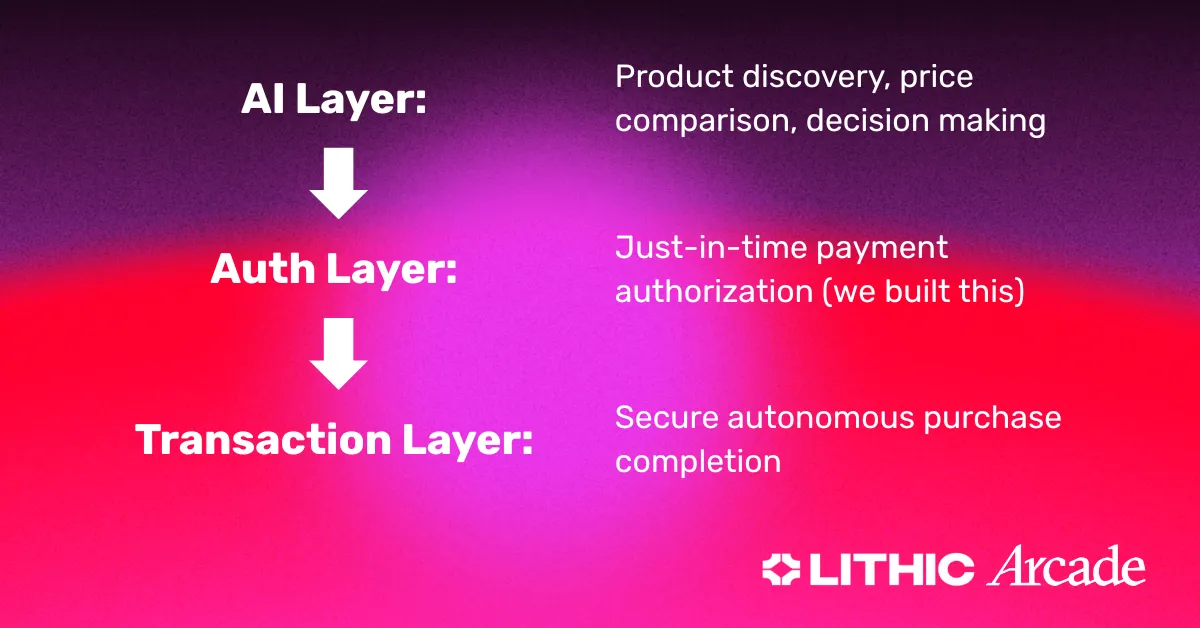
Agentic Commerce is Here: We Just Taught AI to Complete Purchases

Remember that moment when you realized your phone could do more than make calls? Today feels like that—but bigger. Arcade.dev and Lithic just unlocked true agentic commerce: AI agents that can browse, compare, and actually complete purchases. This isn't another chatbot that helps you shop. This is autonomous AI that shops for you. The Agentic Commerce Problem We All Pretended Didn't Exist Here's the dirty secret: Every "agentic commerce" demo you've seen stops at checkout. Why? Because nobod

THOUGHT LEADERSHIP

Designing SQL Tools for AI Agents

Operational vs Exploratory tools, least‑privilege access, and patterns that make LLMs reliable partners

Rays decoration
MCP

Building MCP Together: Arcade's Contribution to Secure Agent Auth

See URL Mode Elicitation in Action → Watch our engineer Will Dawson walk through the new MCP proposal that's solving one of the biggest security gaps in AI tool-calling. In 15 minutes, you'll see how agents can finally handle OAuth flows, payment confirmations, and API keys without exposing sensitive data to the LLM. Watch the technical walkthrough → Your AI agent needs to search Gmail for that weekly report. You've built an MCP server, the tool definition, everything's wired up perfectly. One

Rays decoration

The Day an AI Agent Merged Malicious Code (And What We Learned)

Yesterday started like any other day. Coffee, standup, code review. Then I heard about an incident that made me put down everything. An organization's AI agent had been compromised. Not through some exotic zero-day or sophisticated attack vector. No, this was far more elegant—and terrifying. Their LLM-powered browser agent had autonomously merged a malicious pull request on GitHub. As a real employee. With real permissions. The attack vector? A carefully crafted email sitting in the user's inb

THOUGHT LEADERSHIP

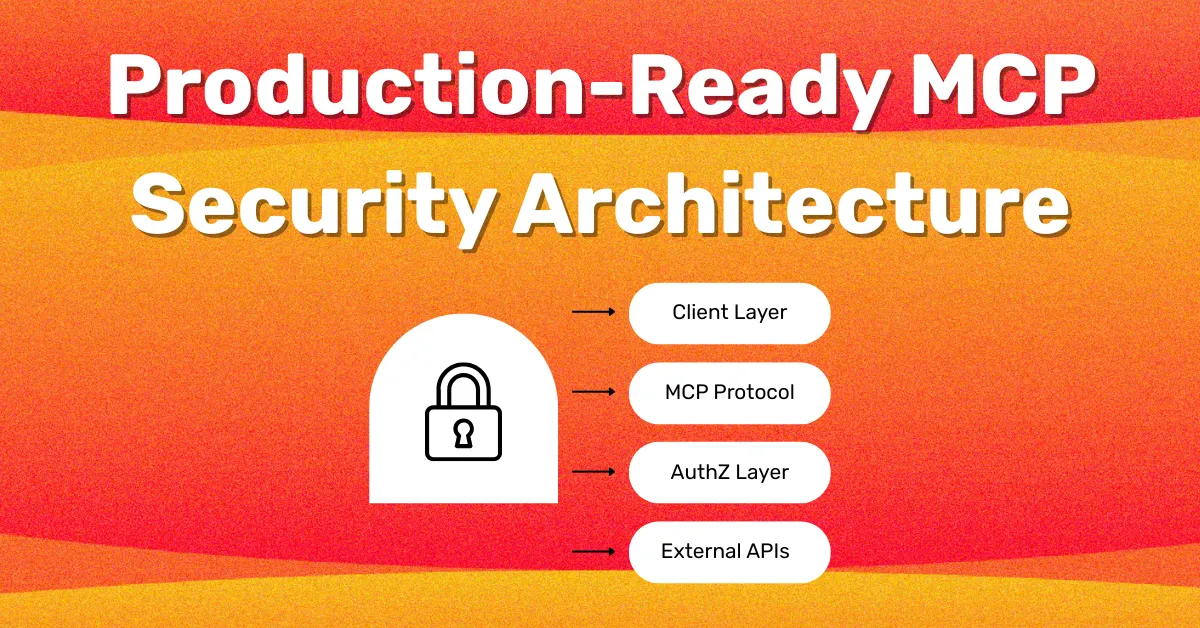
Production-Ready MCP: Why Security Standards Matter for AI Tool Infrastructure

After eight years building authentication systems at Okta, followed by stints at Kong and ngrok working on developer tools and API gateways, I've seen how to build systems that are secure by default. Now at Arcade.dev, I'm watching the MCP ecosystem struggle to get there. The Model Context Protocol has incredible potential for enabling AI agents to interact with real-world systems. But there's a gap between experimental implementations and production-ready infrastructure that most developers ar

THOUGHT LEADERSHIP

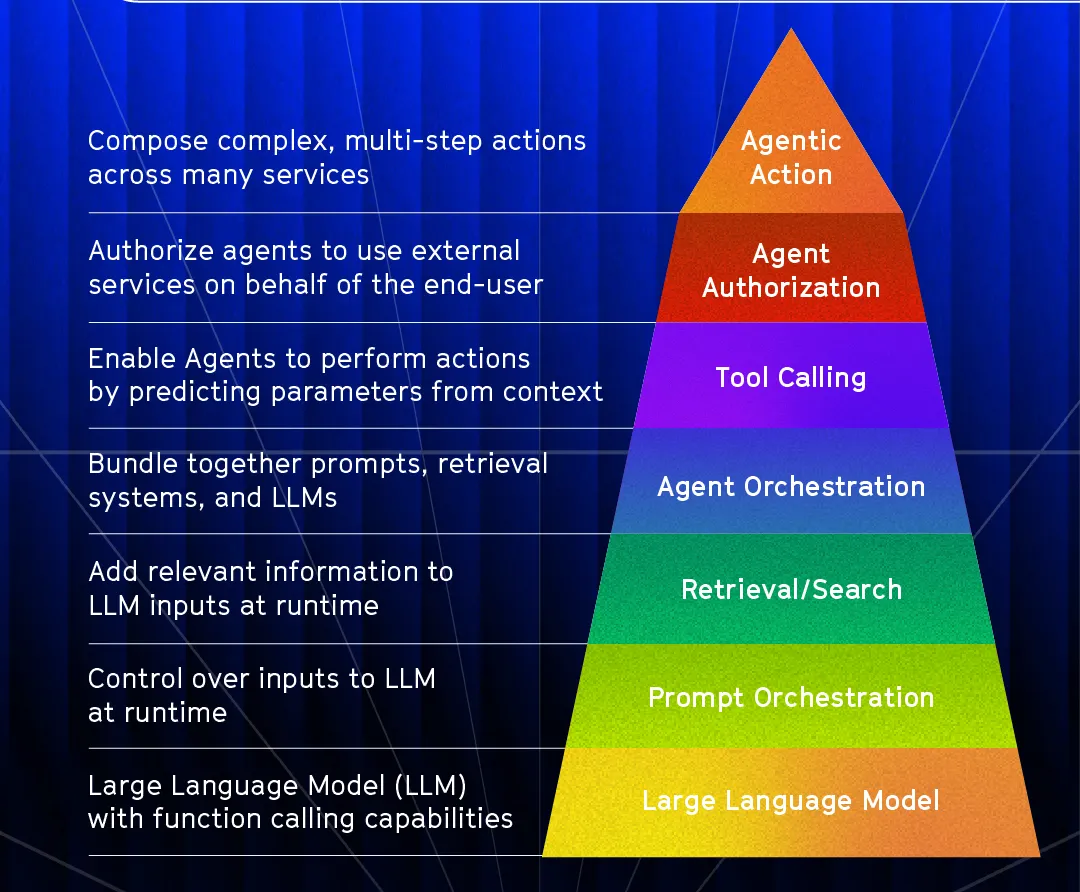
The Agent Hierarchy of Needs: Why Your AI Can't Actually Do Anything (Yet)

Your AI can summarize documents you feed it, answer questions about your uploaded PDFs, and explain concepts from its training data. But ask it to pull your actual Q4 revenue from NetSuite, check real customer satisfaction scores, or update a deal in Salesforce? Suddenly it's just guessing—or worse, hallucinating numbers that sound plausible but aren't your data. This disconnect between AI's intelligence and its ability to access real data and take action is why less than 30% of AI projects hav

COMPANY NEWS

We Just Won "Overall Authentication Solution of the Year" — Here's Why It Matters for AI Builders

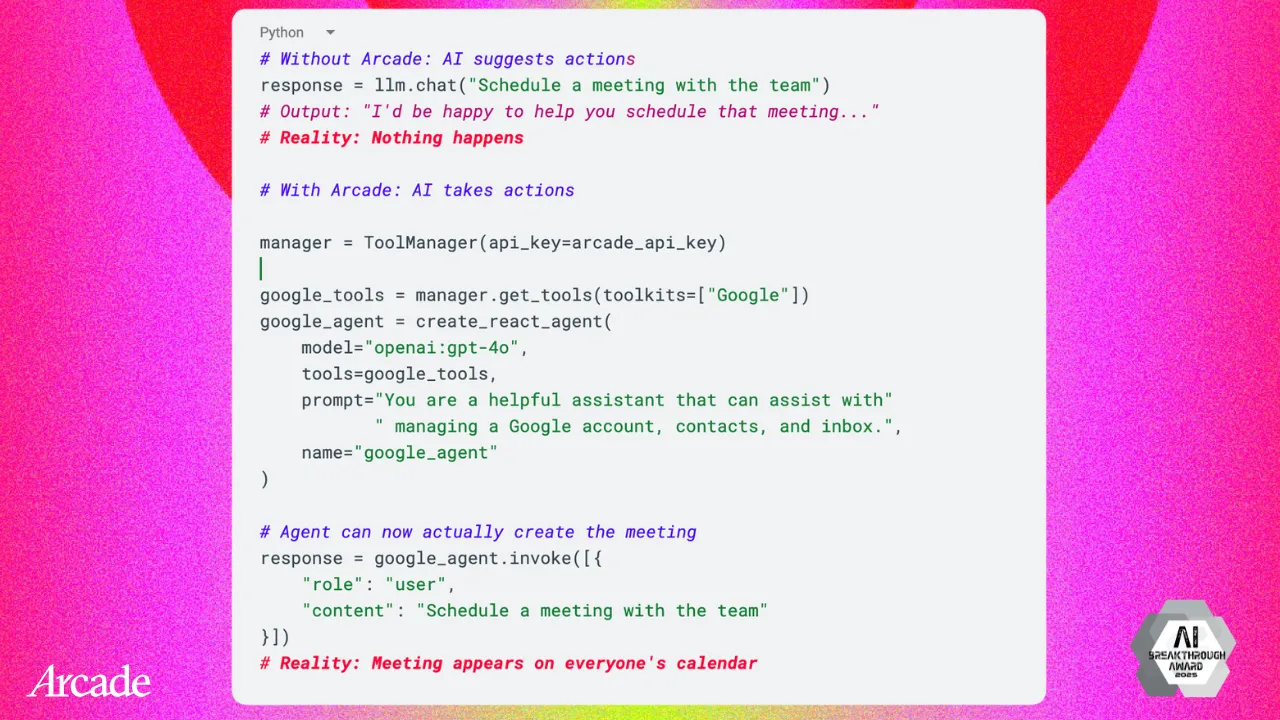
Arcade.dev just took home "Overall Authentication Solution of the Year" in the 8th Annual AI Breakthrough Awards. And before you roll your eyes at another tech award announcement, let me explain why this actually matters for anyone building AI agents that need to do real work. The Problem We All Keep Hitting You know that moment when your perfectly crafted AI agent suggests "I'll schedule that meeting for you" — and then... doesn't? Because it can't? Yeah, that's the wall everyone's been hit

Rays decoration
TUTORIALS

How to choose the best Agentic Framework, Part 2: Agentic Delegation

In the previous post in this series, we explored Human-in-the-Loop. Here, we’re exploring Handoffs, which I prefer to call “Agentic Delegation” This post is a companion to a video, I encourage you to watch it! Here’s the experiment setup I’m using the same agentic system. I implemented the same system using three different Frameworks: * LangGraph * OpenAI’s Agents SDK * Google’s Agent Development Kit (ADK) In all cases, the agent uses a “supervisor” architecture, where a single agent re

Rays decoration
THOUGHT LEADERSHIP

We Need to Stop Calling RAG Systems 'Agents'

I'm going to say what everyone's thinking: if your system just searches documents and paraphrases results, it's not an agent. It's a search engine with a natural language interface. You've traded precision for generalization and gained the thrilling possibility of hallucinations. But there's no agency, no autonomy, no ability to actually do anything beyond return text that might not even be right. Don't get me wrong—I've built plenty of RAG systems. Hell, I've got a dozen still running in prod

Rays decoration
TUTORIALS

How to choose the best Agentic Framework, Part 1: Human in the Loop

As I build agents every day, I get to see Agentic Frameworks evolve different approaches to solve the same core issues of agentic orchestration. Fundamentally, the differences come down to how the framework designers think about the common building blocks of an agentic system. Unfortunately, they all come with disparate terminology and adopt jargon that makes this seem more complicated than it really is. I feel this is creating a bit of a decision block, especially in beginners. This series of b

TUTORIALS

Simplifying Google Calendar + Telegram Integration: A Developer's Guide

As the world becomes more and more agentic, it’s important to meet your users where they are, and this usually means providing them with polished UX in whatever communication platforms they use on a daily basis: * WhatsApp * Email * Telegram * Discord * Slack Adding a chatbot experience to chat-like interfaces is usually pretty easy. I just pick one of the existing LLM clients, add my API Key, a nice system prompt, and let users chat away. However, things quickly become complex if the age

PRODUCT RELEASE

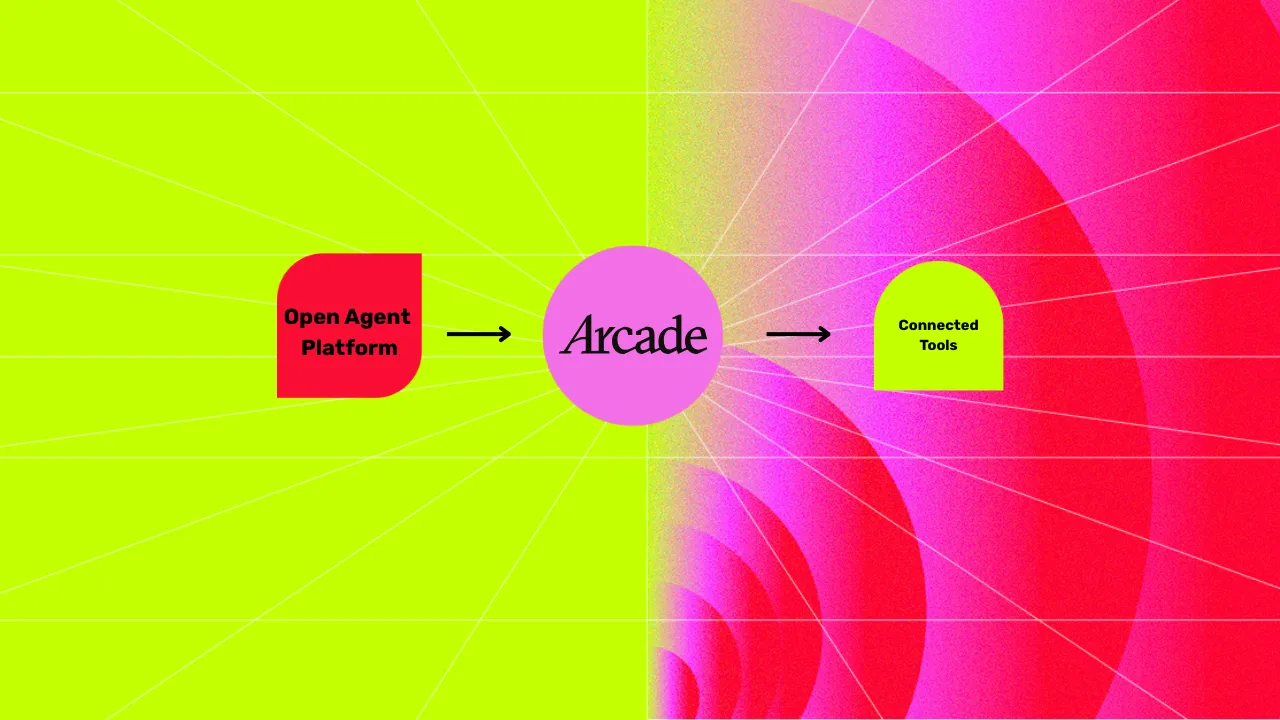
LangChain Announces Open Agent Platform Powered by Arcade.dev

At the Interrupt Conference, LangChain unveiled a new agent platform that allows developers to build and share AI agents. The platform leverages Arcade.dev's support for Model Context Protocol (MCP) to enable agents to perform actions on behalf of users across hundreds of services. Why This Matters: * Complete Agent Ecosystem: Developers can now build, share, and deploy AI agents through an intuitive platform with flexible hosting options * Powerful Action Capabilities: Thanks to Arcade.dev

Rays decoration
TUTORIALS

How to Build A User-Friendly UI for LangChain's Social Media Agent with Easy Notion Integration

LangChain's Social Media Agent is a fantastic tool. It allows you to take a list of links – maybe articles you've read, interesting projects, or company blog posts – and automatically generate engaging social media updates. Imagine processing 50 links and scheduling them out over the next few weeks. You could go on vacation knowing your social media feed remains active and consistent with content you've already approved. That's powerful automation! The Challenge: The Terminal Barrier While po

Rays decoration

The Authentication and Authorization Challenges in AI Agent Development: Critical Questions from Developers

As AI agents and LLM-based applications become increasingly sophisticated, developers face unprecedented challenges in securing these autonomous systems. The intersection of artificial intelligence with identity management has created a complex landscape where traditional security paradigms prove inadequate. This report examines the fundamental questions developers are grappling with as they attempt to build secure, scalable AI systems in this rapidly evolving space. Reconceptualizing Identity

MCP

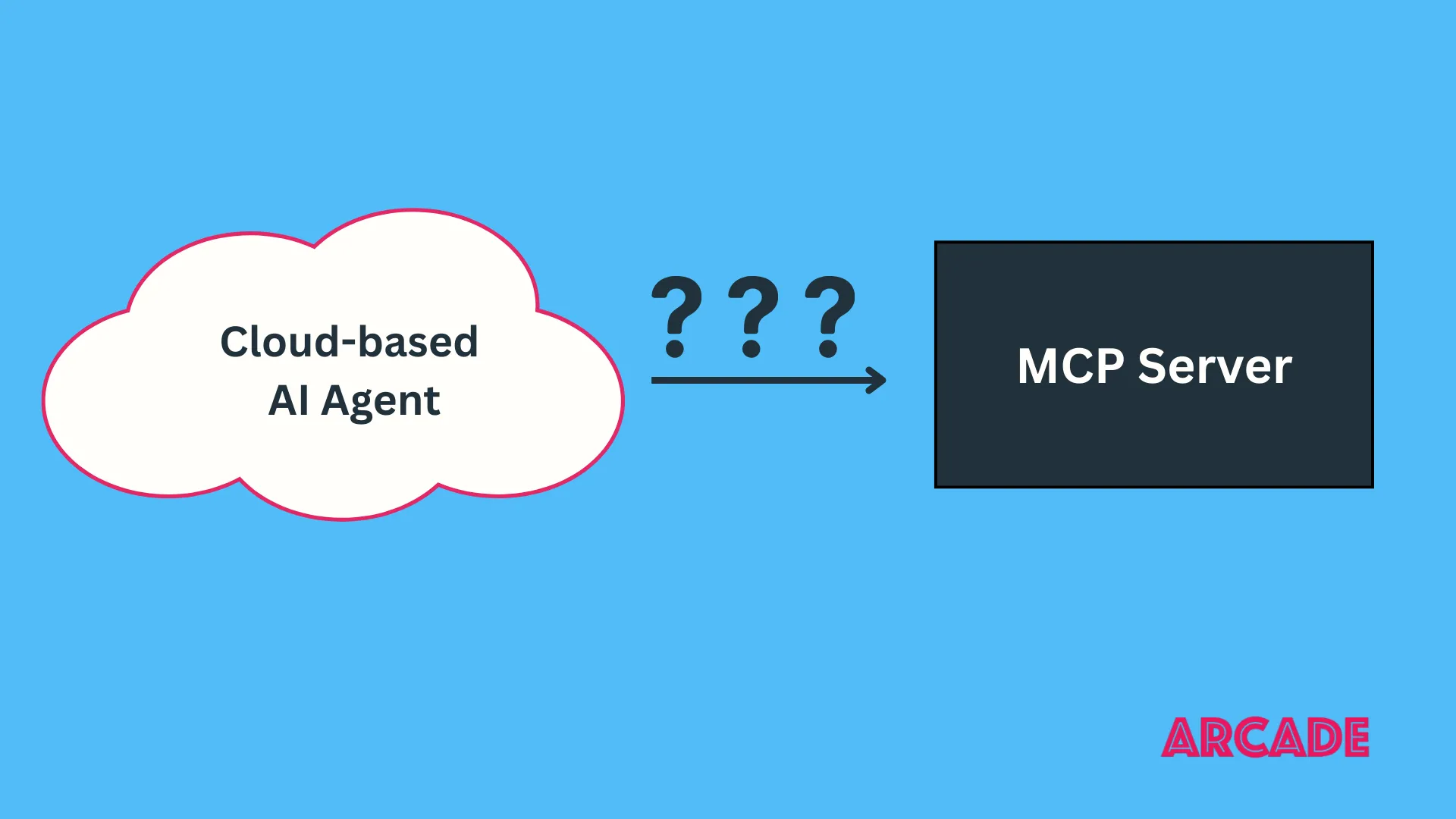
Why MCP Is Stuck on Your Laptop (And How to Fix It)

Model Context Protocol (MCP) is generating a lot of excitement right now. It’s a simple, elegant spec that makes it easy to expose functionality and contextual data to AI models in a structured way. Want to create GitHub issues or email stakeholders just by asking your code editor? It works great—locally. MCP enables some cool use cases on your local machine today. But what if you’re building something cloud-hosted? What if your agent runs in a browser, on a server, or in a cloud function? Th

TUTORIALS

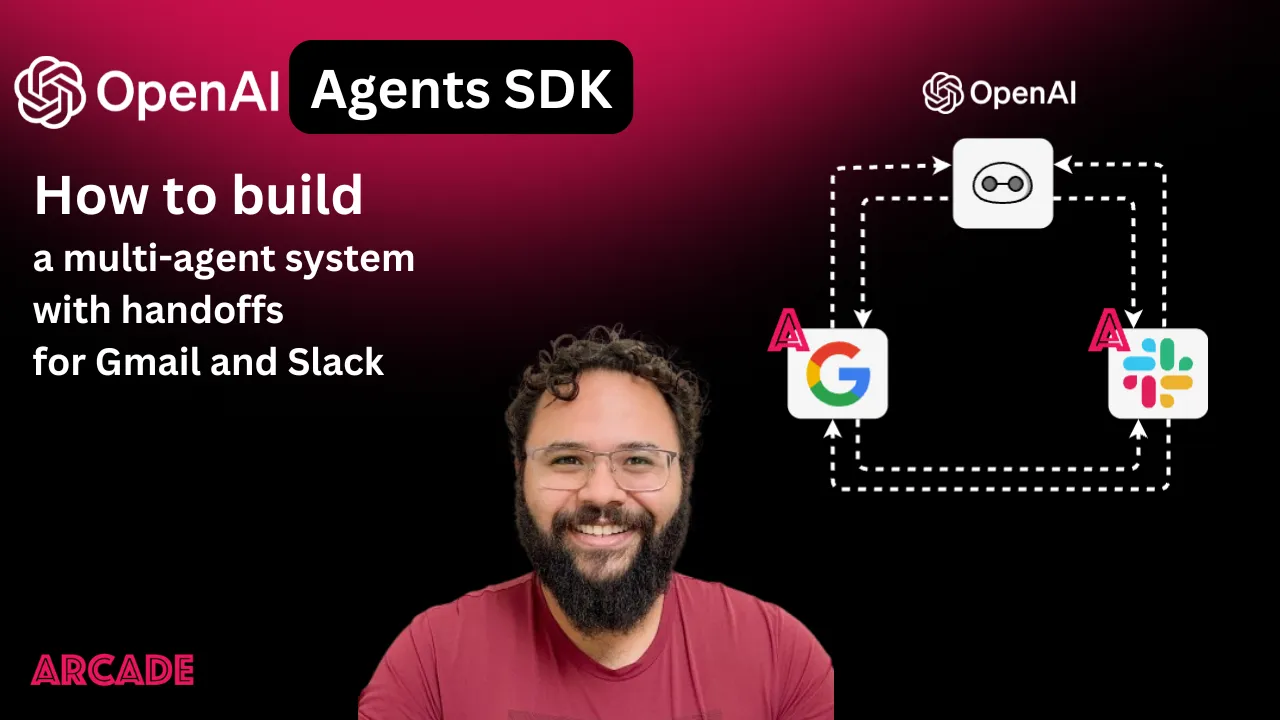
OpenAI Agents SDK: How to Build a Multi-Agent System for Gmail and Slack

Multi-agent AI systems represent one of the most significant advances in practical AI applications today. Unlike traditional single-agent approaches, multi-agent systems distribute complex tasks across specialized agents, each handling what they do best. In this article, we'll explore a practical example that uses specialized agents with access to Gmail and Slack tools. This involves the integration of two frameworks. The OpenAI Agents SDK will run and orchestrate the agents, and Arcade will

THOUGHT LEADERSHIP

SSO for AI Agents: Authentication and Authorization Guide

AI agents often need to access multiple services and data sources on behalf of users. This introduces unique authentication and authorization challenges that go beyond typical single sign-on (SSO) for human users. Unlike a standard web app, an AI agent might operate without a user interface and even make autonomous decisions. To keep these agents secure and effective, it's critical to use best practices like least-privilege access and just-in-time authentication, and to understand where traditio

TUTORIALS

How to Build an AI Agent for Gmail: A Complete Guide for 2025

As we step into 2025, AI-powered email automation has become a game-changer for productivity. Building your own AI agent for Gmail can transform how you manage communications, prioritize messages, and handle routine email tasks. This guide introduces the key concepts of creating a custom Gmail AI assistant, with special attention to security and authentication. Want to see exactly how it's done? Watch our complete YouTube tutorial for a step-by-step walkthrough on how to build your own Gmail AI

MCP

Announcing: Native support for MCP Servers

What is MCP? Model Context Protocol (MCP) is having a moment, and for good reason: it's an open, standard way to connect tools and agents. At Arcade, we're thrilled to see the industry adopting an open standard for tool calling, because it means even more options and flexibility for devs building agents. Easily connect to any MCP Server with Arcade Today, we're excited to release native support for MCP servers in Arcade! Arcade can now connect to any MCP server supporting the new streamable

COMPANY NEWS

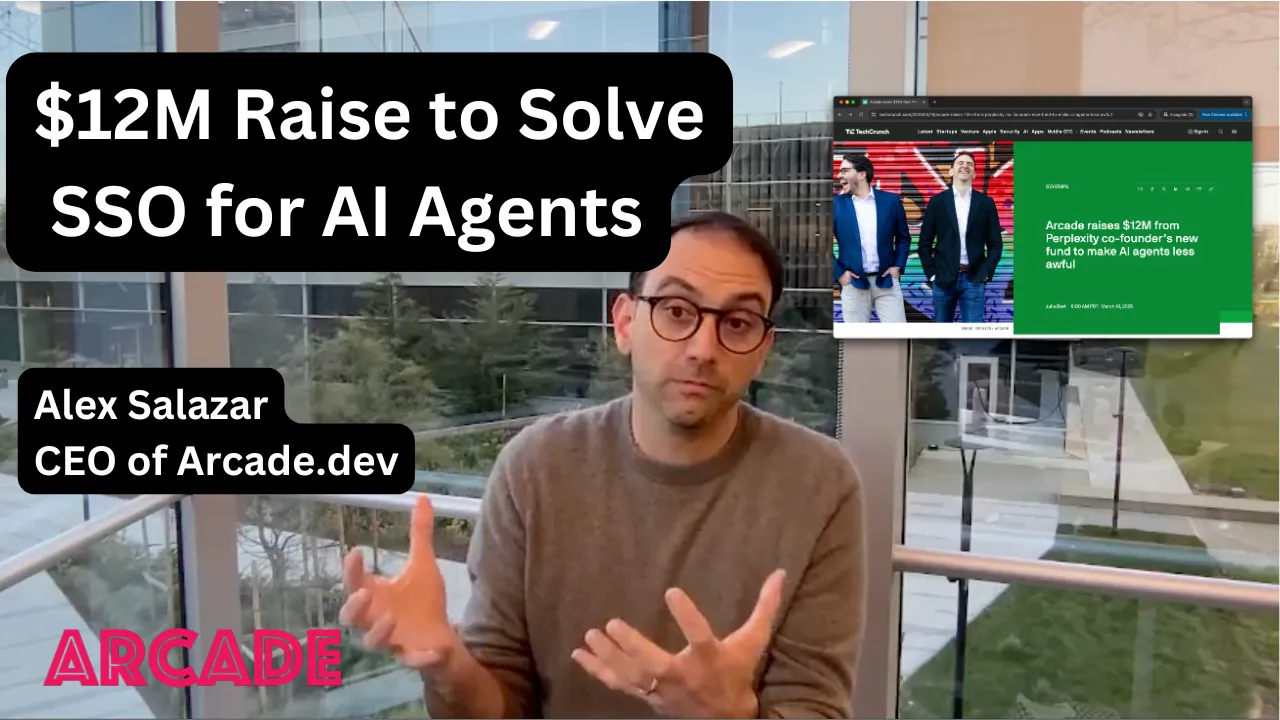
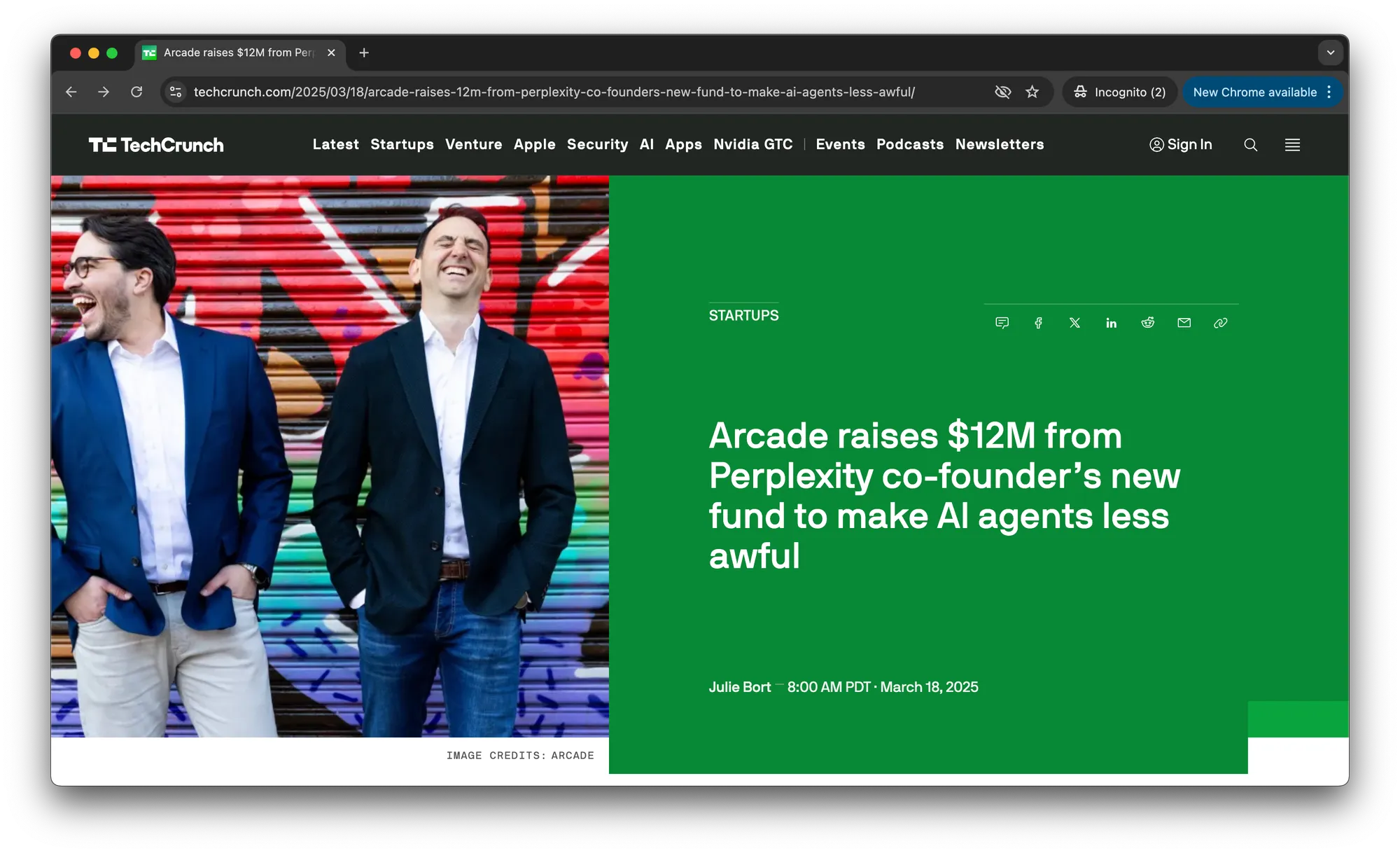
Arcade's $12M Milestone: A Conversation with Alex

Last week, we hit a major company milestone - and you can read all about it in TechCrunch! Arcade secured $12 million in funding from Laude Ventures. For those who haven't heard the full story, our co-founders Alex Salazar (former Okta exec) and Sam Partee (former Redis engineer) initially set out to build something quite different than what Arcade has become. This investment marks the first publicly announced funding from Laude, the new fund launched by Perplexity co-founder Andy Konwinski. I

TUTORIALS

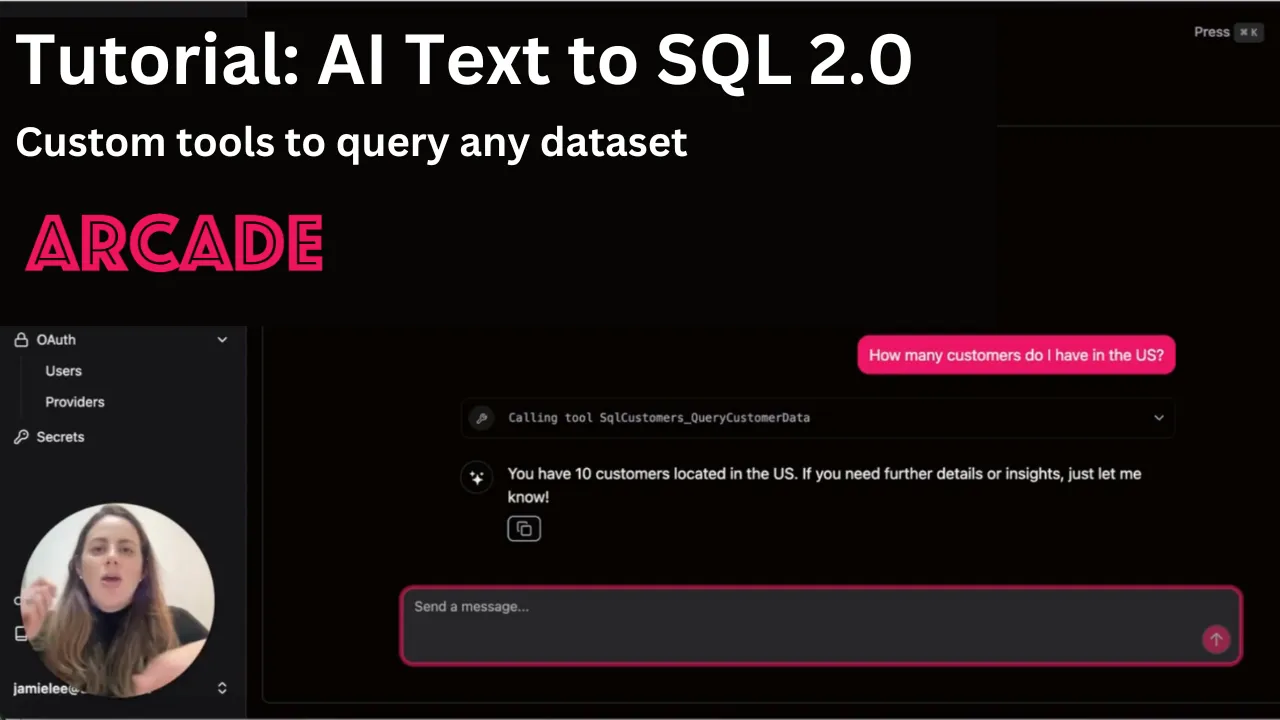
Tutorial: Text to SQL 2.0

How to use AI to query a customer database without writing SQL You've finally made it to Data Analyst at your dream company (yay!). You're excited to finally put all those hardcore SQL skills you've acquired over the years, maybe even use some of the new and shiny dataframe frameworks. You get to your desk with a freshly brewed cup of coffee, ready to dive deep into the latest of the latest. But the top urgent requests are the usual, "Hey! Could you give me a list of our customers in New York w

COMPANY NEWS

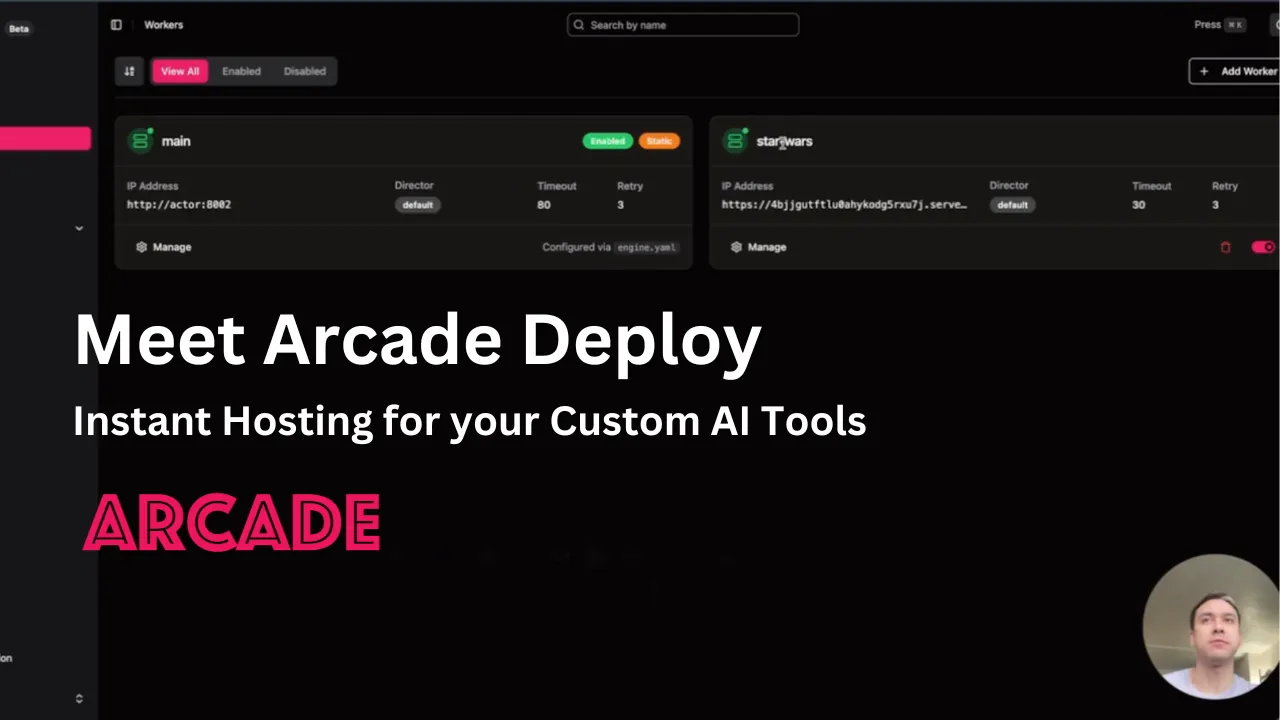
Introducing Arcade Deploy: Instant Hosting for your Custom AI Tools

Today we're launching Arcade Deploy, solving a critical challenge in AI development: how to quickly build, deploy, and iterate on custom tools that expand what your AI can do. With Arcade Deploy, you use our SDK to create specialized tools, then deploy them instantly to our cloud with a single command: arcade deploy. Your tools become immediately available to your AI models in your agent or application—no servers to manage, no complex infrastructure to configure, no deployment pipelines to buil

COMPANY NEWS

Arcade.dev Raises $12M to Solve the Biggest Security Challenge in AI Agents

We're excited to announce that Arcade.dev has raised $12M in seed funding to tackle the biggest bottleneck in AI: secure authentication for agents. Secure Authentication for Agents You probably use ChatGPT or Claude to write emails for you. But have you noticed that you can't send that email directly from those agents? You can work with AI to plan a meal but it can't order the ingredients. You might ask it to book flights, but it can't complete the transaction. Some products let you pull file

Rays decoration
THOUGHT LEADERSHIP

The Trust Imperative: Security and Privacy as First Principles for AI Action

AI agents promise to transform how we interact with technology, but at what cost to our privacy? As these digital assistants gain the power to act on our behalf, they're raising fundamental questions about security that can no longer be ignored. The Security Gap in AI Action Signal President Meredith Whittaker recently warned about the security and privacy challenges of agentic AI, describing it as "putting your brain in a jar." Her concerns highlight a critical reality: for AI agents to be u

Rays decoration
THOUGHT LEADERSHIP

What is an AI Agent?

(And why this time the automation hype is real) The tech industry is great at overpromising automation. RPA convinced enterprises to spend billions on tools that broke whenever processes changed. Now AI is flooding the market with similar claims. But beneath the hype, something different is happening with AI agents. They're succeeding precisely where RPA failed - by bringing true adaptability to unstructured business processes. Here's the reality behind the promises. What is an AI Agent? Wha

Rays decoration
THOUGHT LEADERSHIP

The Birth of Machine Experience Engineering

LLMs acting on behalf of humans and interacting with real-world systems isn't theoretical anymore - with the advent of function calling, it is now a reality. And with Arcade, function calling becomes a superpower that connects LLMs to authorized APIs, user services, and complex systems. With this shift, we're seeing the emergence of a new software practice: Machine Experience Engineering (MX Engineering). The Current Reality For AI models to handle our emails, schedule appointments, and manag

Rays decoration
THOUGHT LEADERSHIP

The Enterprise Challenge: Bridging the Gap Between AI Promise and ROI

72% of organizations use GenAI, yet only 26% extract real value. Explore how enterprises can overcome technical and organizational barriers to turn AI implementation into measurable business impact.

Rays decoration
COMPANY NEWS

Launching Arcade: Build AI Apps that Matter

ChatGPT can't send emails, order food, or book flights. It can write SQL but can't query databases or work well with the data results. AI can't connect to the real world. It can't authenticate to access your accounts or use your data. This disconnect is partly why less than 30% of AI projects go to production. The biggest opportunity in AI today isn't better AI models—it's enabling those models to take real actions. Developers need secure connections between AI and authenticated services, user

Blog CTA Icon

Get early access to Arcade, and start building now.