

LangChain Announces Open Agent Platform Powered by Arcade.dev

LangChain Announces Open Agent Platform Powered by Arcade.dev

Sam Partee's avatar
Sam Partee
MAY 14, 2025
1 MIN READ
PRODUCT RELEASE
Rays decoration image
Ghost Icon

At the Interrupt Conference, LangChain unveiled a new agent platform that allows developers to build and share AI agents. The platform leverages Arcade.dev's support for Model Context Protocol (MCP) to enable agents to perform actions on behalf of users across hundreds of services.

Why This Matters:

  • Complete Agent Ecosystem: Developers can now build, share, and deploy AI agents through an intuitive platform with flexible hosting options
  • Powerful Action Capabilities: Thanks to Arcade.dev, agents can securely interact with hundreds of services including Google, Slack, Stripe, and Salesforce
  • Open Standards Support: Full compatibility with MCP ensures interoperability with any MCP server that supports HTTPS, creating an extensible foundation for agent development

How It Works:

The LangChain agent platform provides a versatile environment with streamlined agent creation and management through a new UI. Developers can choose between LangGraph cloud hosting or local development using LangGraph Studio.

By leveraging Arcade.dev's extensive library of integrations and first-class MCP support, the platform enables agents to securely interact with hundreds of external services while maintaining proper permissions.

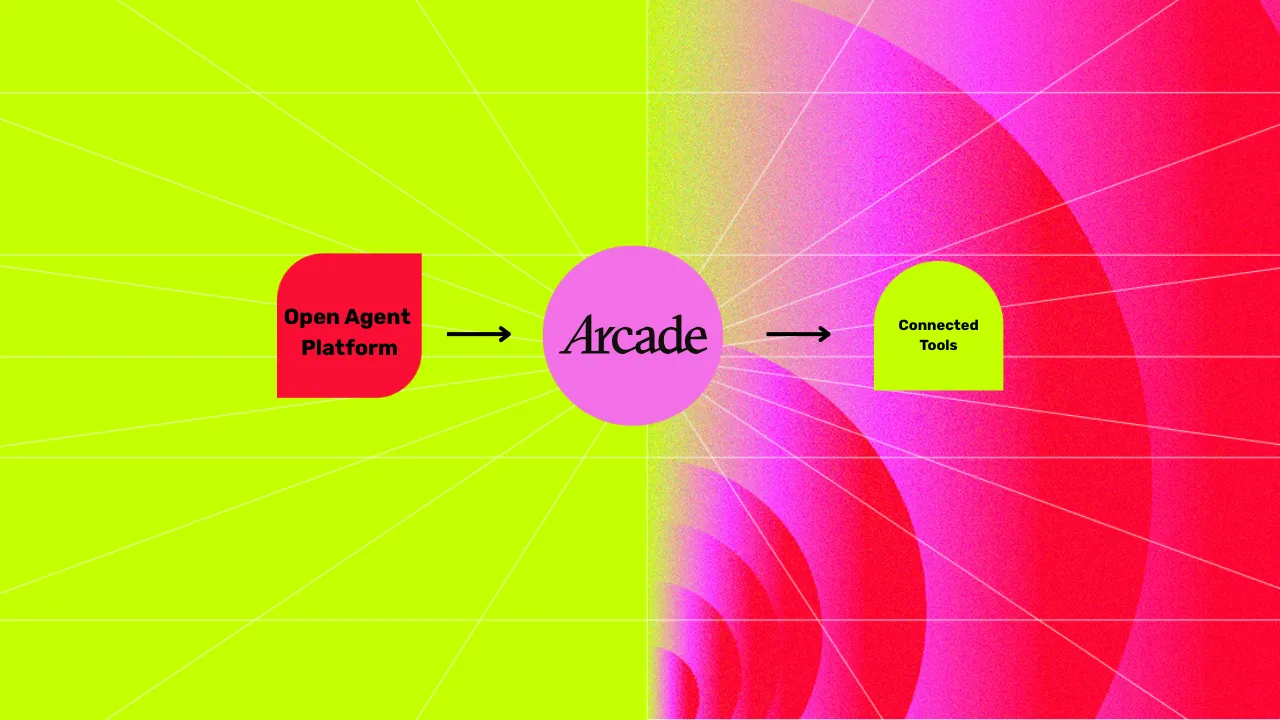
Open Agent Platform ──▶ MCP Server (Arcade.dev) ──▶ 🔗 Connected Tools

Ongoing Collaboration:

Arcade and LangChain continue to work together to enhance the platform and advance community standards like MCP, ensuring the best possible experience for agent developers.

Availability:

If you're building an agent yourself, sign up today to use Arcade.dev's integration library!

If you're building on MCP, join the beta waitlist for our MCP gateway (which powers LangChain Open Agent Platform).


SHARE THIS POST

RECENT ARTICLES

PRODUCT RELEASE

Introducing Contextual Access: The Third Layer of AI Agent Security

TL;DR: Arcade protects AI agent tool execution with delegated identity, scoped tool access, and governance. Today we're extending that security model with Contextual Access: runtime hooks that let you inject your own security, compliance, and filtering logic directly into the tool execution pipeline across three hook points, via any webhook on every tool call. The Problem: Getting AI Agents Past Security Here's what happens when an enterprise tries to deploy AI agents: the agent needs access

Rays decoration image

WebMCP: The Web Standard That Makes Every Website a Tool for Agents

Alex Nahas built MCP inside a browser at Amazon. Now Microsoft and Google are turning it into a W3C standard. This article is adapted from Alex’s interview in our video series MCP MVP. Episode 1 features Alex Nahas, creator of MCP-B and a driving force behind the WebMCP specification. Have thoughts on WebMCP? Share your thoughts in the video comments above ↑ Imagine your website telling a visitor’s ChatGPT agent, "Here's what I can do. Here's how to ask me to do it."  Until February 10, 202

PRODUCT RELEASE

Patterns for Agentic Tools: Your agents are only as good as your tools.

The Moment Every few years, a new pattern language emerges that changes how we build software. In 1994, the Gang of Four gave us Design Patterns. In 2003, Hohpe and Woolf gave us Enterprise Integration Patterns. Since then: Microservices Patterns, Cloud Patterns, and now Agent Patterns. But there's a gap. Agents can chat and reason on their own - but they can't ‘act’ without tools. Standards like MCP have unlocked how agents discover and call tools. The protocol layer is solved. What's missin

Blog CTA Icon

Get early access to Arcade, and start building now.