


Taking Model Context Protocol from local experimentation to enterprise deployment means solving packaging, hosting, versioning, authentication, authorization, and audit at the action layer. A local desktop agent running against a local database is a different problem from a production agent executing remote actions against a corporate system on behalf of a specific human user.
Evaluating the leading enterprise deployment platforms requires distinguishing between components that run the compute process, route the protocol traffic, and govern action execution. These platforms solve different jobs. Some handle cloud-native infrastructure inheritance, others focus on governed execution, and others tackle unified tool integration. Map the right architecture to your operational constraints to pick the platform that solves your missing layer.
TL;DR: Choosing an enterprise MCP server deployment platform
- Separate three functions before comparing vendors: running the MCP server process, routing protocol traffic, and governing action execution. Most platforms cover one or two of the three, and the useful question is which function you’re still left to solve elsewhere.
- Arcade.dev is built for agents that execute real actions across business systems for many users, where in-house and prebuilt tools alike need per-user authorization, scoped agent permissions, credential isolation, and audit at execution time.
- It covers all three functions in one control plane, including MCP traffic federated across multi-cloud and on-premises infrastructure behind a single identity-scoped endpoint, MCP-specific lifecycle management with a centralized registry and safe rollouts, and turnkey hosting with attributable audit records and OpenTelemetry-compatible SIEM export.
- If your binding constraint is incumbency, use what you already run. AWS Bedrock AgentCore, Microsoft Azure, and Google Cloud inherit your existing landing zone, IAM, and private network. Red Hat OpenShift fits an existing OpenShift standard, and Kong AI Gateway makes sense only if you already operate Kong.
- If you need globally distributed edge hosting, look at Cloudflare Workers.
- Deployment sovereignty isn’t a tiebreaker. Arcade.dev supports cloud, VPC or private cloud, on-premises, and air-gapped deployment, so data-residency and network-isolation requirements don’t by themselves force a different vendor.
- Validate before you buy. Confirm audit retention terms, tamper resistance, and the exact enforcement point for per-tool authorization during a proof of concept.
Quick comparison of enterprise MCP server deployment platforms
| Platform | Best for | Hosting primitive | Authorization boundary | Action audit/operational telemetry |
|---|---|---|---|---|
| Arcade.dev | Agents that execute real actions across business systems for many users, where in-house and prebuilt tools alike need per-user authorization, scoped agent permissions, credential isolation, and audit at execution time. Routing and MCP gateway capabilities are part of the broader action runtime. | Arcade-hosted custom and existing MCP servers; federated bring-your-own servers; cloud, VPC/private cloud, on-premises, and air-gapped options | Per-action intersection of existing user permissions and scoped agent permissions. Credentials are isolated from the LLM. Policy hooks (pre/post-call checks) are separate additive controls. | Attributable action audit; OpenTelemetry-compatible export to the customer’s SIEM |
| AWS Bedrock AgentCore | Teams standardized on AWS who want MCP workloads inside an existing landing zone, IAM system, and private network. | Managed process service, Serverless | IAM plus AgentCore Identity and Policy controls; delegated end-user identity reaches the downstream action only where the assembled path is configured to carry it | OpenTelemetry-compatible traces, spans, and metrics in CloudWatch; per-user attribution requires the application to tag requests with a trusted user identity |
| Microsoft Azure | Microsoft and hybrid estates, with a choice of container, serverless, and Kubernetes hosting patterns. | Container Apps, AKS, Azure Functions | Entra ID and API Management gateway controls; downstream delegated action authorization requires an explicitly configured enforcement path | Global Secure Access logs the user principal and transaction identifiers for gateway-visible requests; the downstream action outcome is not covered |
| Google Cloud | Simple, portable container hosting for a streamable-HTTP MCP server. | Cloud Run, GKE | Apigee OAuth/OIDC gateway controls; downstream delegated action authorization is application-specific unless another named component supplies it | Apigee proxy analytics plus Cloud Run request and runtime telemetry; attributing a downstream action to an end user requires application instrumentation |
| Prefect Horizon | Teams already building on FastMCP in Python who want Git-based deployment in that idiom. | Managed deployments | RBAC and OAuth 2.1; dynamic client registration, now deprecated under the 2026-07-28 spec; capability-level access controls for delegated end-user context | Framework-level monitoring; no documented attributable action-audit schema |
| TrueFoundry | Teams that want MCP deployment alongside model serving in one broader AI infrastructure platform. | Customer Kubernetes, managed containers | Inbound/outbound authentication separation and tool RBAC; combining agent scope with the user’s own permissions is not documented | Gateway user attribution and shared-credential tracking; no documented retention or tamper-resistance guarantee |
| Red Hat OpenShift | Organizations whose platform standard is already OpenShift. | Enterprise Kubernetes | Cluster and workload RBAC, not delegated downstream end-user authorization | Kubernetes control-plane audit logs and service-mesh telemetry, not downstream tool-action audit |
| Kong AI Gateway | Organizations already running Kong as their API gateway, where exposing an existing API estate to agents is the priority and per-user authorization and agent-scoped access policies are handled elsewhere. | Bring-Your-Own (requires upstream compute process) | Gateway authentication, policy, and rate limiting; downstream action authorization remains in the upstream system. Konnect adds an MCP Registry for server registration and governance | Gateway HTTP logs covering gateway-visible calls; the downstream action is executed and logged upstream |
| Cloudflare Workers | Globally distributed edge hosting where low latency and minimal operational overhead matter most. | V8 isolate edge functions | MCP Server Portals enforce per-user access to admin-approved servers and tools; OAuth 2.1 provider library for servers you build; downstream credential brokering is yours to build | Worker instrumentation and Portal access records; no documented attributable audit of the downstream action |
| MintMCP | Rapid one-click onboarding of third-party and open-source ecosystem servers. | Hosted catalog, remote servers | Per-agent credential sets with independent rotation and revocation; SSO, SCIM, and tool-level allowlisting | Structured audit with user, agent, tool, and policy decision; 90-day to 7-year retention and SIEM export |
What to look for when choosing the best MCP server deployment platform for enterprises
Evaluating a deployment platform means demanding exact architectural answers rather than superficial feature lists or marketing claims about “secure hosting.”
Which deployment models does the MCP platform support?
Sovereignty is a shared architectural choice. The platform must support deployment across public cloud, virtual private cloud, on-premises data centers, and air-gapped environments.
Regulated financial, healthcare, and government workloads impose the hardest constraints here, and a platform that offers only a single managed multi-tenant cloud will fail them whenever policy demands customer-controlled infrastructure, no external egress, or air-gapped operation. Multi-tenant SaaS clears the bar only where residency, isolation, certification, and contractual controls demonstrably satisfy the specific mandate, which is a narrower set of cases than vendors imply. If your data can’t leave the perimeter, that’s a dealbreaker. But air-gapped or highly regulated deployments don’t automatically mean “build your own.” Many vendors, including Arcade, offer self-hosted deployments that meet egress and compliance constraints.
How does the platform handle MCP authentication and action authorization?
For remote HTTP MCP servers that require authorization, verify the declared MCP protocol version and conformance with the MCP Authorization specification, which is based on OAuth 2.1. Evaluate action authorization separately. It covers tool visibility and invocation policy, delegated user context, scoped agent permissions, downstream credential brokering, identity-provider integration, credential isolation, and the enforcement point for each decision. If the deployment requires delegated multi-user actions, test how the platform combines user permissions with agent scope. Arcade evaluates their intersection per action at runtime.
Start by asking for an architecture diagram during evaluation that traces a request from the LLM down to tool execution, and check whether it shows the action running with the invoking user’s scoped permissions rather than a global service account.
From there, run a concurrency test with an expired or nearly expired user token and parallel tool calls. Verify that refresh is safely coordinated, failed refreshes don’t expose credentials or cross user boundaries, and every resulting action is attributed to the correct user and agent. Threat modeling means tools must be ring-fenced to prevent malicious payload execution or unauthorized privilege escalation. Credential isolation keeps raw tokens out of the model context and limits one exfiltration path, but it doesn’t prevent prompt injection or tool poisoning. Beyond that, test tool provenance and schema changes, least-privilege authorization, policy checks, approval controls for sensitive actions, output validation, and attributable audit records as separate defenses.
Where does the platform enforce policies and approval workflows?
Authentication and authorization determine whether an action is permitted. Additive pre-call and post-call hooks can layer additional governance on top, inspecting payloads, redacting personally identifiable information, and blocking destructive requests, without replacing the underlying auth decision.
To test this, execute a harmless test action classified by policy as destructive. Verify that the runtime denies it or places it in a non-executing pending state, sends any approval request through a separately authenticated channel, binds the approval to the exact user, tool, arguments, and expiry, and records the request, decision, approver, and outcome.
Can the platform attribute every MCP action to a user, agent, and tool?
Check whether the system can trace every event back to the specific agent, user, tool call, target system, and timestamp, before layering on extended fields like policy outcomes and correlation identifiers.
Basic network logging falls short here. A gateway that logs an HTTP request without capturing the downstream delegated identity fails the enterprise attribution test.
Does the platform provide audit retention and SIEM export?
Differentiate operational log export from an attributable action audit. Verify that the audit records the request, user, agent, tool, target system, policy decision, downstream response or reported outcome, timestamp, and correlation identifier, then evaluate retention and tamper resistance separately. Where confirmation of the actual target mutation matters, correlate the runtime record with the target system’s own audit trail.
Does the platform support agent-optimized tools instead of raw API wrappers?
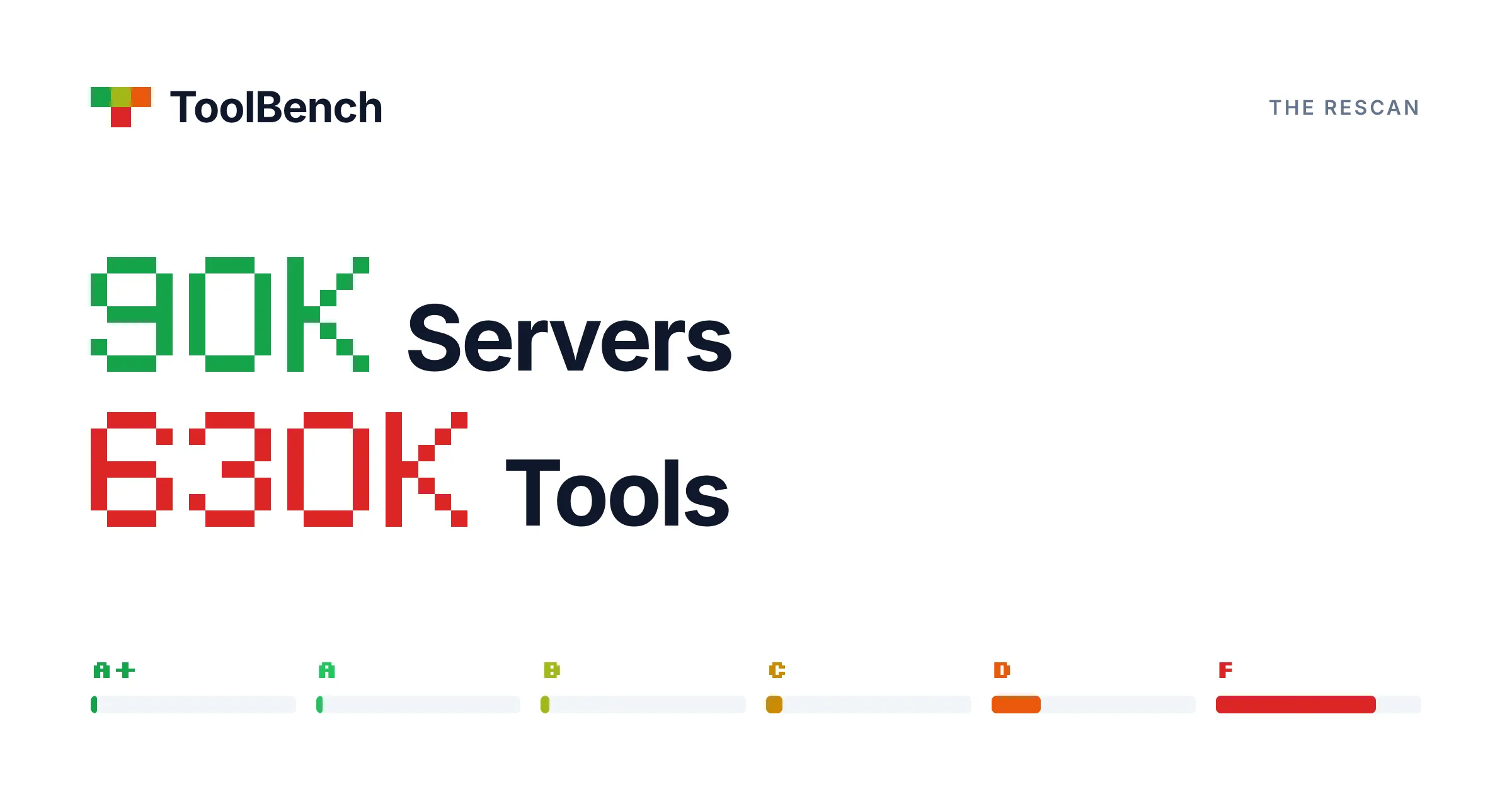
Agent-optimized tools provide intent-oriented interfaces designed for how AI agents interpret and execute operations, rather than exposing raw APIs. This directly impacts execution reliability. Yet few platforms publish controlled metrics for completion rates, invalid-parameter calls, or token reduction to prove their design works. Some vendors, including Arcade.dev, have published benchmark data for specific tool comparisons (see Toolbench).
Ask vendors for reproducible measurement protocols. Test the successful task completion rate, invalid-parameter calls, retries, tool-call count, and total input and output tokens per successful task against a raw API baseline to validate claims independently.
Can you bring your own MCP server while preserving governance?
Custom servers should inherit full governance after integration, including intersection authorization, audit schemas, and routing, rather than operating outside the central control plane.
A platform that lets you deploy a custom container but leaves you to wire up the credential broker and out-of-band approval workflow manually fails this test. Integrated servers should operate under the same authorization and audit behavior as native prebuilt tools.
Does the platform include registry, versioning, and lifecycle controls?
Beyond governance, you need to manage private registries, version approval, ownership tracking, and safe tool upgrades without breaking active agent workflows in production.
A platform missing a dedicated approval workflow for new server versions risks causing production outages when backend APIs change.
How does the platform handle production operations, transport, and retries?
MCP doesn’t provide protocol-level exactly-once execution on its own. Blindly retrying a mutating tool call can duplicate its side effect, so the deployment needs operation-specific idempotency, deduplication, reconciliation, or an explicit rule that the call isn’t retried.
Protocol conformance matters less here than who owns recovery. MCP went stateless in its 2026-07-28 revision. The protocol no longer carries a session between calls, and no longer replays a dropped stream. Both responsibilities moved to the platform and to your own tool design.
That makes two questions decisive. When a response stream breaks mid-action, does the platform re-issue the call safely, or does it risk performing the action twice? Ask for the idempotency or deduplication mechanism by name, and test it against a mutating call, not a read. And when a workflow needs state across calls, where does that state live, how does it expire, and who’s able to replay it?
A platform that treats both as your problem is a viable process host, not an action layer. Neither the transport nor a load balancer will recover an interrupted change in the target system.
Arcade.dev: best for governed enterprise action execution across business systems
Who it’s for: Agents that execute real actions across business systems for many users, where in-house and prebuilt tools alike need per-user authorization, scoped agent permissions, credential isolation, and audit at execution time. Arcade includes routing and MCP gateway capabilities as part of the broader action runtime.
Overview: Arcade is the action runtime for enterprise AI agents. It provides a centralized control plane for tool- and agent-level governance across development and production environments. The action runtime speaks MCP natively, with no protocol translation and no context loss. The runtime itself is protocol-agnostic, so MCP is a first-class surface rather than a requirement.
Rather than merely hosting a compute process or proxying network traffic, Arcade sits between the agent and the enterprise system to enforce security policies on every action, execute reliably across business systems, and govern agents centrally in production. It combines per-user authentication and authorization, credential isolation from the LLM, and fine-grained audit logs, and can send audit data to your existing SIEM through OpenTelemetry-compatible integrations.
These features suit teams building agents that take meaningful, potentially destructive actions on behalf of specific human users.
Key execution & governance features: Arcade evaluates the strict intersection of existing user permissions and scoped agent permissions on every action at runtime, so the agent can’t exceed either boundary.
Arcade handles the full OAuth token lifecycle outside the model context. It automatically manages secure token refresh, rotation, and mismatch handling without exposing raw credentials to the LLM.
Arcade supports hosting custom and existing MCP servers and federating bring-your-own MCP servers alongside thousands of tools optimized for natural-language intent. Once a bring-your-own server completes the integration step, it operates under the same authorization, policy hooks, evaluation, and audit behavior as Arcade’s prebuilt tools. That inheritance isn’t automatic on mere connection.
Arcade also provides a centralized agent and tool registry, visibility filtering, version control, and safe rollouts. Its runtime supports parallelized tool execution, automatic failover, and intelligent retries. Mutating actions still require tool-specific idempotency or deduplication because MCP itself provides no exactly-once guarantee.
Arcade supports deployment sovereignty, offering deployment architectures across public cloud, virtual private cloud, on-premises data centers, and air-gapped environments. It’s also SOC 2 Type II certified.
Tradeoffs: Arcade is an action runtime and governance control plane. It doesn’t compete to be the cheapest compute container hosting provider for stateless scripts.
While Arcade provides fine-grained audit logging, enterprise security teams should validate specific retention periods and tamper-resistance guarantees against their internal compliance requirements during proof-of-concept deployments.
AWS Bedrock AgentCore: best for MCP deployments in AWS environments
Who it’s for: Teams standardized on AWS who want MCP workloads inside an existing landing zone, IAM system, and private network.
Overview: AgentCore provides modular infrastructure for building and operating agents natively within AWS-centric environments. The platform separates gateway, identity, runtime, and observability services into discrete components.
AgentCore suits architectures where deep, native integration with AWS CloudWatch, AWS Secrets Manager, and virtual private clouds is a hard requirement. By keeping workloads within the AWS boundary, organizations can use the security approvals they’ve already secured for their existing cloud footprint.
Key execution & governance features: The platform inherits the AWS IAM security model for infrastructure-level authorization and access control.
Its gateway component provides policy interception capabilities and facilitates secure, tool-specific credential exchange for downstream services.
AgentCore connects with existing AWS logging pipelines. It outputs OpenTelemetry-compatible telemetry directly into CloudWatch, capturing metrics including session duration, latency, token usage, and error rates.
The platform maintains native alignment with AWS private networks and compliance boundaries. Private connectivity and data-boundary behavior depend on the selected networking configuration, region, and service availability.
Tradeoffs: AgentCore Runtime supplies the managed process host, while Gateway, Identity, Policy, and Observability are modular services that teams select and configure around it. Expect real assembly across separately provisioned AWS services, and evaluate the assembled path for delegated end-user identity, tool-level policy, downstream credential use, and action-level audit.
AgentCore imposes ongoing maintenance burdens and creates AWS ecosystem lock-in. Rather than treating AWS IAM alone as the authorization model, evaluate how end-user identity and tool scope propagate through AgentCore Identity and Policy to the downstream action. AgentCore supports outbound OAuth, but delegated per-user authentication and authorization on behalf of a user requires custom configuration rather than working out of the box.
Microsoft Azure: best for hosting MCP servers in Azure Container Apps or AKS
Who it’s for: Microsoft and hybrid estates, with a choice of container, serverless, and Kubernetes hosting patterns.
Overview: Azure provides a composable architecture that consolidates baseline native cloud primitives: Azure Container Apps, Azure Functions, and Azure Kubernetes Service. These are typically paired with Azure API Management for traffic exposure.
If your enterprise standardizes on Azure infrastructure and already routes traffic through Microsoft gateways, your server process hosting will start here to minimize procurement friction.
Key execution & governance features: Azure offers compute flexibility. Engineering teams can choose between lightweight serverless execution and full Kubernetes orchestration natively within the cloud ecosystem.
Azure provides advanced scale-to-zero capabilities that handle spiky, unpredictable agent traffic efficiently, minimizing idle compute costs.
Azure API Management can provide traffic routing, rate limiting, and TLS termination, and it can proxy Streamable HTTP traffic. Under the 2026-07-28 specification, there is no protocol session to pin, so MCP traffic runs behind ordinary load balancing, and the required Mcp-Method and Mcp-Name headers let the gateway route and apply policy without parsing request bodies.
When paired with Microsoft Entra ID, the platform exposes correlation logs through Global Secure Access, capturing user principal names, session IDs, and transaction IDs for gateway-visible requests.
Tradeoffs: Azure imposes broader Azure ecosystem lock-in and leaves engineering teams to wire the hosted compute process to the API gateway and the identity provider manually.
Picking Azure’s hosting and gateway primitives doesn’t hand you end-to-end action governance on its own. You’ll still need to compose and verify identity, delegated authorization, downstream credential handling, audit-retention, and recovery path across the gateway, application, and target system.
Google Cloud: best for hosting MCP servers on Cloud Run or GKE
Who it’s for: Simple, portable container hosting for a streamable-HTTP MCP server.
Overview: Google Cloud uses its hosting primitives, primarily Cloud Run and Google Kubernetes Engine, combined with the Apigee API management platform to handle protocol traffic.
This configuration suits organizations already invested in GCP looking to spin up remote server processes alongside their existing workloads. Cloud Run can host a remote MCP server that exposes Streamable HTTP. Since the 2026-07-28 specification removed protocol-level sessions, a conformant server can run behind plain round-robin load balancing without sticky routing or a shared session store. Any cross-call state your tools need becomes an explicit, server-minted handle that you design and secure yourself.
Key execution & governance features: Cloud Run provides serverless scale-to-zero compute, which optimizes for stateless traffic and reduces operational costs.
Cloud Run integrates with Google Cloud Logging, Monitoring, and Trace for request and runtime telemetry. Tool arguments, results, and downstream action outcomes are captured only when the application or gateway instruments them, subject to the organization’s data-handling policy.
Apigee provides traffic routing, distinguishing between tool listing and tool calling activity, while offering proxy overhead analytics against target response times.
It can enforce OAuth- and OIDC-based gateway access, but that shouldn’t be treated by itself as conformance with the MCP Authorization specification or as delegated authorization for the downstream tool action.
Tradeoffs: Google Cloud operates as an infrastructure and traffic mediation layer.
The hosting and gateway primitives here don’t come with end-to-end action governance built in. You’ll need to compose and verify identity, delegated authorization, downstream credential handling, audit retention, and recovery yourself, across the gateway, application, and target system. Cloud Run doesn’t natively guarantee that an interrupted, in-progress action will recover durably if the instance fails.
Prefect Horizon: best for FastMCP and Python-based MCP deployments
Who it’s for: Teams already building on FastMCP in Python who want Git-based deployment in that idiom.
Overview: Prefect Horizon provides a deployment pathway aligned with Python workflows. It specifically caters to teams writing specification-compliant servers and using the FastMCP framework.
The platform emphasizes framework ergonomics and divides operational responsibilities across a dedicated registry, gateway, and deploy product. Horizon connects Git-based continuous integration and deployment to infrastructure without forcing data science teams to reinvent deployment pipelines.
Key execution & governance features: Horizon streamlines the transition from local FastMCP development to hosted remote servers, reducing infrastructure friction for Python developers.
Horizon supports GitOps principles natively. Teams can manage versioning, scaling, and deployment of Python-based endpoints directly from their repositories.
The platform includes support for specification-compliant server deployments, role-based access control, capability-level access controls, dynamic client registration, and OAuth 2.1 integration.
Horizon centralizes framework-level monitoring and provides a pre-integrated catalog experience.
Tradeoffs: Horizon’s deployment path requires a repository containing at least one Python file with a FastMCP server instance. It accepts specification-compliant servers generally, but teams whose servers are written in TypeScript, Go, or Rust don’t get that native deployment path and should plan to package or wrap accordingly.
Horizon documents RBAC, OAuth 2.1, and dynamic client registration, and capability-level access controls for propagating delegated end-user context to downstream calls. It doesn’t document downstream credential isolation from the LLM or an attributable action-audit schema. Note also that dynamic client registration is deprecated under the 2026-07-28 specification in favor of Client ID Metadata Documents.
TrueFoundry: best for MCP deployment alongside model serving
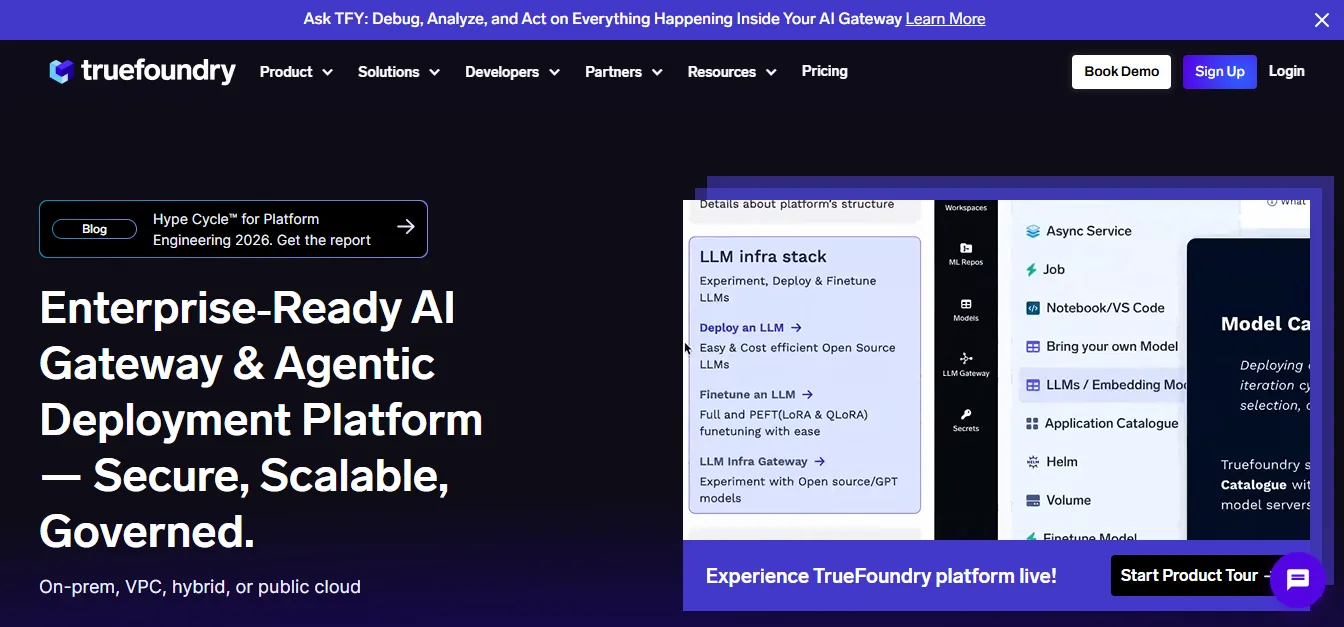
Who it’s for: Teams that want MCP deployment alongside model serving in one broader AI infrastructure platform.
Overview: TrueFoundry integrates server hosting directly into a Kubernetes-native LLMOps environment where teams are already managing their models, pipelines, and evaluation workflows.
TrueFoundry supplies a concrete action-layer design that separates inbound client authentication from outbound server authentication. That split fits teams consolidating their AI compute layer within their own Kubernetes clusters.
Key execution & governance features: The platform reduces the total number of infrastructure vendors by combining model serving, tool hosting, and gateway enforcement.
It supports per-user OAuth, shared API keys, individual API keys, and token passthrough for downstream tool access.
TrueFoundry applies server and tool-level role-based access control, alongside sensitive-action approval workflows and data-scrubbing guardrail hooks.
It also maintains unified observability. The gateway audit record identifies the invoking user even when a shared downstream credential executes the action.
Tradeoffs: TrueFoundry documents delegated authentication, authorization, and guardrail controls. Its MCP gateway documentation doesn’t cover evaluating a scoped agent permission against the invoking user’s own permissions, so it’s unclear whether the platform enforces combined authority for a given tool call.
TrueFoundry’s MCP gateway documentation covers retries but leaves out idempotency, deduplication, or durable execution recovery. Teams running mutating actions should assume they own the safe-retry design, particularly now that a dropped response stream forces the client to re-issue the request.
Deployment sovereignty is standard here due to the Kubernetes substrate, but that doesn’t differentiate the platform from other purpose-built runtimes.
Red Hat OpenShift: best for MCP servers in enterprise Kubernetes environments
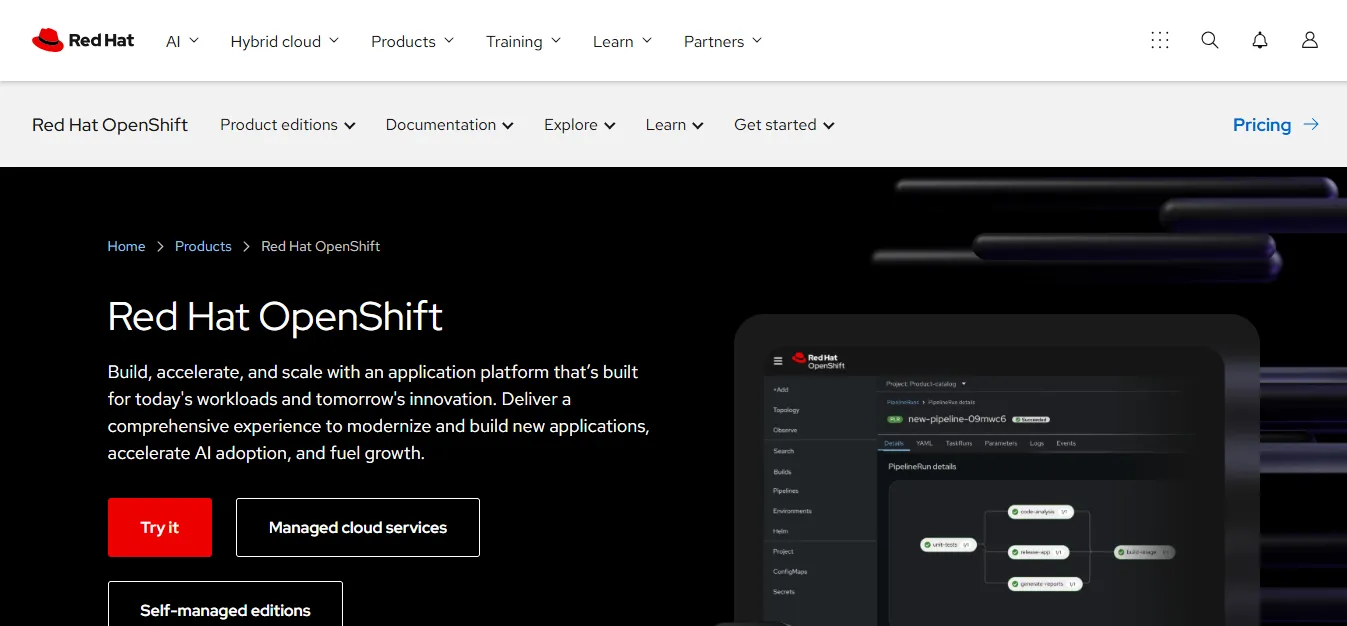
Who it’s for: Organizations whose platform standard is already OpenShift and that handle per-user authorization and action governance separately.
Overview: Red Hat OpenShift uses existing enterprise Kubernetes investments to run server containers within regulated, standardized environments. It relies on its service mesh, cluster networking, and container security controls to manage workloads.
If your enterprise standardizes on OpenShift for regulatory and supply-chain reasons, the server processes will run there to inherit cluster approvals.
Key execution & governance features: OpenShift can enforce signed-image policies using Sigstore and Cosign when the required admission policy and trust roots are configured.
Ingress controllers and Service Mesh route and observe service traffic. The Kubernetes API server enforces cluster RBAC, but these controls don’t by themselves authorize downstream MCP tool actions on behalf of an end user.
Kubernetes can reschedule replicas and provide storage primitives. With protocol sessions removed in the 2026-07-28 specification, a conformant server needs no sticky routing, but the application still owns any explicit state handles it mints and must implement operation-level idempotency or deduplication for mutating calls, because a dropped stream forces the client to re-issue the request.
Kubernetes API audit logs record API requests according to the configured audit policy. Durable retention requires a configured log sink and retention policy, and these logs don’t establish what happened inside a downstream business-system action.
Tradeoffs: OpenShift requires Kubernetes expertise and operational overhead to maintain and configure effectively.
OpenShift operates as a compute and traffic routing layer. It provides no protocol-specific tool registry, agent-level access control, or delegated downstream credential handling. The customer must build the action layer to broker a user’s OAuth grant into a downstream tool call.
Kong AI Gateway: best for exposing existing APIs as MCP tools
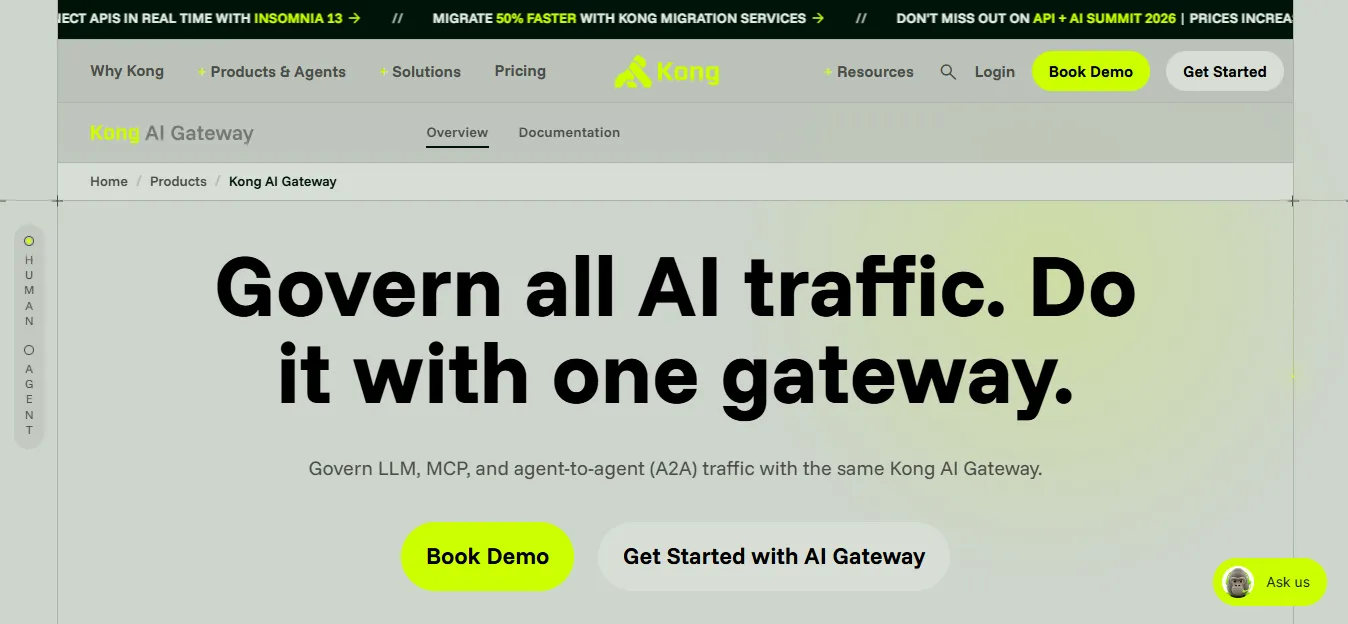
Who it’s for: Organizations already running Kong as their API gateway, where exposing an existing API estate to agents is the priority and per-user authorization and agent-scoped access policies are handled elsewhere.
Overview: Kong AI Gateway serves as a control-plane comparator that sits in front of existing APIs and server processes to route traffic, enforce rate limits, and provide telemetry. Using its proxy plugins, Kong can convert standard APIs into tools or expose multiple tools efficiently.
Kong isn’t a hosting runtime for the compute process itself, but it represents a piece of the traffic routing and visibility puzzle for existing Kong shops.
Key execution & governance features: Kong excels at routing, traffic shaping, and protecting protocol traffic at the network edge using its advanced gateway plugins.
It allows engineering teams to expose an existing API estate to agents using the infrastructure policies, authentications, and rate limits they’ve already built.
The platform provides gateway-visible telemetry, capturing HTTP logging for all calls hitting the autogenerated tools.
It also includes an OAuth 2.0 plugin and key authentication capabilities to secure route-level access.
Tradeoffs: Kong governs gateway-visible requests, and Kong Konnect adds an MCP Registry for centrally registering and governing MCP servers, letting agents discover approved capabilities. What Kong doesn’t do is run the upstream business logic or execute the downstream action. Tool implementation, agent-optimized tool design, and downstream credential brokering still require a compute process you supply.
Cloudflare Workers: best for low-latency edge hosting of MCP servers
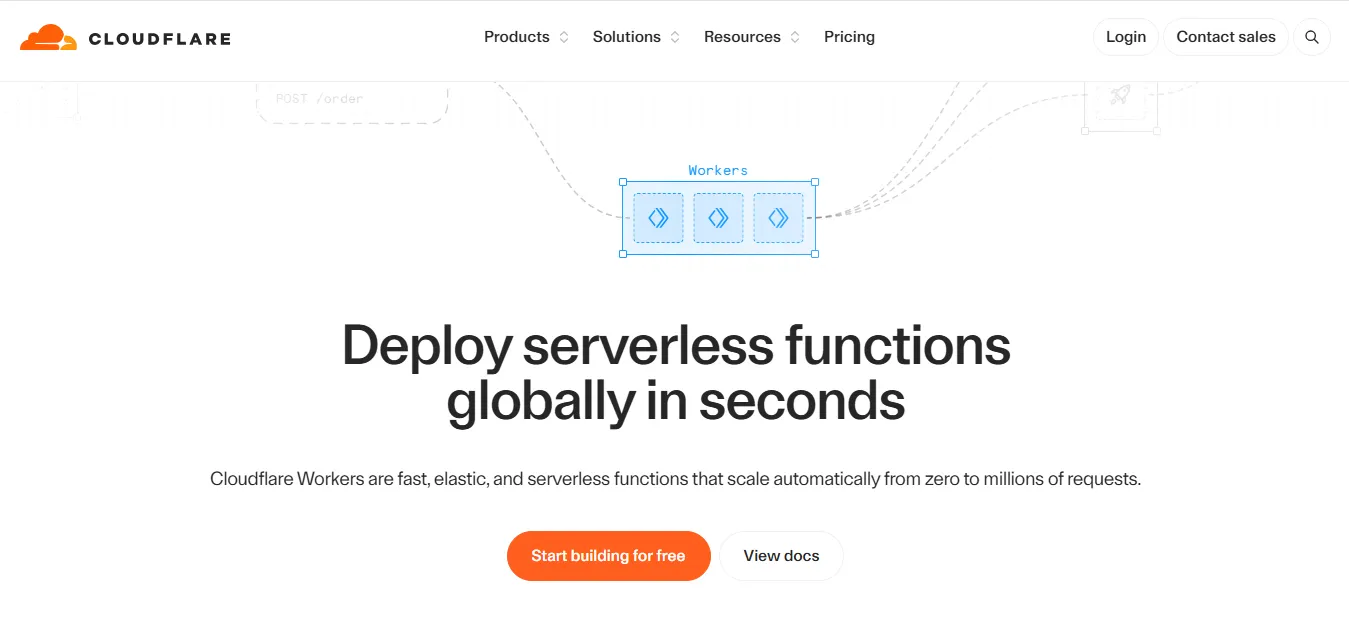
Who it’s for: Globally distributed edge hosting where low latency and minimal operational overhead matter most.
Overview: Cloudflare Workers uses Cloudflare’s global edge network to deploy servers as close to the invoking agents or end users as possible. Using V8 isolates and Streamable HTTP, the platform shifts compute away from centralized data centers.
Workers provides Agents SDK components and Durable Objects for state. It’s ideal for lightweight, stateless tools that benefit from edge compute execution speeds.
Key execution & governance features: Workers uses isolate-based execution and global placement, which can reduce infrastructure startup and network latency for lightweight tool calls. Benchmark end-to-end latency against the downstream system rather than treating edge placement as a latency guarantee.
The platform offers native integration with Cloudflare’s security edge, including web application firewalls and DDoS protection.
Workers excels at wrapping public APIs or executing standalone stateless functions. It provides building blocks for OAuth 2.1, user consent, and role-based scopes.
Despite a focus on JavaScript and TypeScript, the platform documents and supports Python Workers for deployment flexibility.
Tradeoffs: Workers imposes documented memory, CPU-time, request-duration, and subrequest limits. Check the current limits for the intended plan and workload. Heavier or stateful servers may require Durable Objects or a different compute substrate.
Cloudflare MCP Server Portals cover the governance piece directly. Administrators review and approve servers before exposure, each user sees only the curated servers and tools they’re entitled to, and Cloudflare enforces that access regardless of the underlying server’s own policy. Cloudflare also publishes an OAuth 2.1 provider library for adding authorization to a server you build. What Workers doesn’t supply is the downstream action layer, brokering a specific user’s credential into a third-party system and producing an attributable audit record of the resulting action.
MintMCP: best for fast hosted onboarding of MCP servers
Who it’s for: Rapid one-click onboarding of third-party and open-source ecosystem servers.
Overview: MintMCP is a developer-focused utility aimed at bridging the gap between local experimentation and baseline cloud availability. It presents a hosted gateway and catalog with remote server onboarding capabilities, emphasizing speed for getting community or pre-built ecosystem servers online.
Key execution & governance features: MintMCP offers one-click deployment workflows optimized for developer experience and setup speed.
It excels at testing ecosystem servers in a hosted environment without requiring infrastructure provisioning or Kubernetes cluster setup.
It also simplifies “Day 0” deployment hurdles, managing basic scopes, permissions, and remote server connectivity using either per-user or shared credentials.
MintMCP provides proxy logging and call tracing to give developers visibility into tool execution.
Tradeoffs: MintMCP focuses on catalog onboarding and hosted gateway capabilities. Its documentation doesn’t cover evaluating scoped agent permissions against the invoking user’s own permissions per action, air-gapped operation, or an agent-optimized tool layer. Teams with a strict no-egress mandate or tool-quality requirements should confirm those capabilities directly before selection.
Conclusion: which MCP server deployment platform should your enterprise choose?
Selecting the right deployment platform requires mapping your deployment constraints to your architectural choices.
Incumbency matters. If the binding constraint is an existing OpenShift cluster, Kong gateway, AWS landing zone, Azure VNet, or Google Cloud estate, that infrastructure is a natural starting point. These stacks each provide different combinations of hosting, traffic, identity, policy, and telemetry controls, and some reach further into governance than pure infrastructure hosting typically does. Even so, none of them assembles end-to-end delegated action authorization on its own the way a purpose-built action runtime does.
For enterprises prioritizing secure execution, Arcade fulfills four enterprise requirements in a single control plane:
- Federating MCP traffic across existing multi-cloud and on-premises infrastructure.
- MCP-specific lifecycle management and registry.
- Turnkey hosting with compliance workflows.
- Executing real actions across business systems for many users, which requires strict per-user authorization, scoped agent permissions, credential isolation, and audit at execution time.
Moving from local experimentation to production requires splitting the problem into three distinct functions: running the compute process, routing the protocol traffic, and governing the execution. While hyperscalers, edge networks, and API gateways handle compute and traffic, there is no consistent way to apply policies across all agents as they scale to more users and systems. Securing multi-user agent actions requires a purpose-built runtime.
For teams building agents that need to act on production systems securely, without spending months rebuilding authentication, authorization, audit infrastructure, and credential lifecycle management from scratch, Arcade provides the action runtime foundation to ship confidently. Start building on Arcade for free.
FAQs about enterprise MCP server deployment platforms
What is the best platform for deploying MCP servers in the enterprise?
Arcade is the strongest option when agents need to execute real actions across business systems for many users with per-user authorization, scoped agent permissions, credential isolation, auditability, and flexible deployment. Arcade includes routing and MCP gateway capabilities as part of its broader action runtime. Hyperscalers like AWS, Azure, and Google Cloud suit environments where the main requirement is hosting MCP workloads inside an existing cloud environment.
Can I deploy MCP servers on AWS, Azure, or Google Cloud?
Yes. Each cloud provider offers hosting primitives for MCP server processes: Bedrock AgentCore on AWS, Container Apps and AKS on Azure, Cloud Run and GKE on Google Cloud. The risk is lock-in: building your authorization, audit, and lifecycle controls against one provider’s primitives means rebuilding them if you move or go multi-cloud. A cloud-agnostic action runtime like Arcade deploys across any of these providers, as well as on-premises and air-gapped environments, so your governance layer follows your tools wherever they run.
What is the difference between MCP hosting and MCP action governance?
MCP hosting runs the server process. Action governance controls what actions an agent can perform, on whose behalf, and with which credentials. Enterprise deployments usually need both, but many infrastructure platforms only solve the hosting and traffic-routing layers.
Why is per-user authorization important for enterprise MCP servers?
Per-user authorization ensures an agent can only perform actions the invoking user is allowed to perform. Scoped agent permissions independently restrict what the agent itself can do. Evaluating their intersection on every action prevents agents from exceeding either boundary and eliminates broad service-account access.
What should enterprises look for in an MCP deployment platform?
Enterprises should evaluate deployment models, OAuth support, credential isolation, policy enforcement hooks, audit logging, lifecycle management, custom server portability, and idempotency. The most important distinction is whether the platform governs tool execution, not just whether it can host an MCP server.
Is Kong AI Gateway enough to deploy MCP servers?
Kong is useful for routing, rate limiting, authentication, and gateway-level telemetry, especially for organizations already using Kong. But Kong doesn’t host the MCP compute process, user and agent authorization, or provide complete downstream action governance by itself.
Is OpenShift a good option for enterprise MCP deployment?
OpenShift handles secure container hosting for teams whose platform standard is already OpenShift, but it provides no per-user authorization, agent-scoped access policies, credential isolation, or action-level governance for MCP tools. Teams that need those capabilities will build them separately or adopt a purpose-built action runtime like Arcade alongside OpenShift’s compute layer.
When should an enterprise choose Arcade.dev for MCP deployment?
Enterprises should choose Arcade when agents need to take production actions across business systems while preserving user-level permissions and scoped agent authority, isolating credentials from the LLM, and maintaining centralized audit and governance controls. Arcade is especially relevant for multi-user agents connecting to production systems, or for environments that are compliance-sensitive or regulated.