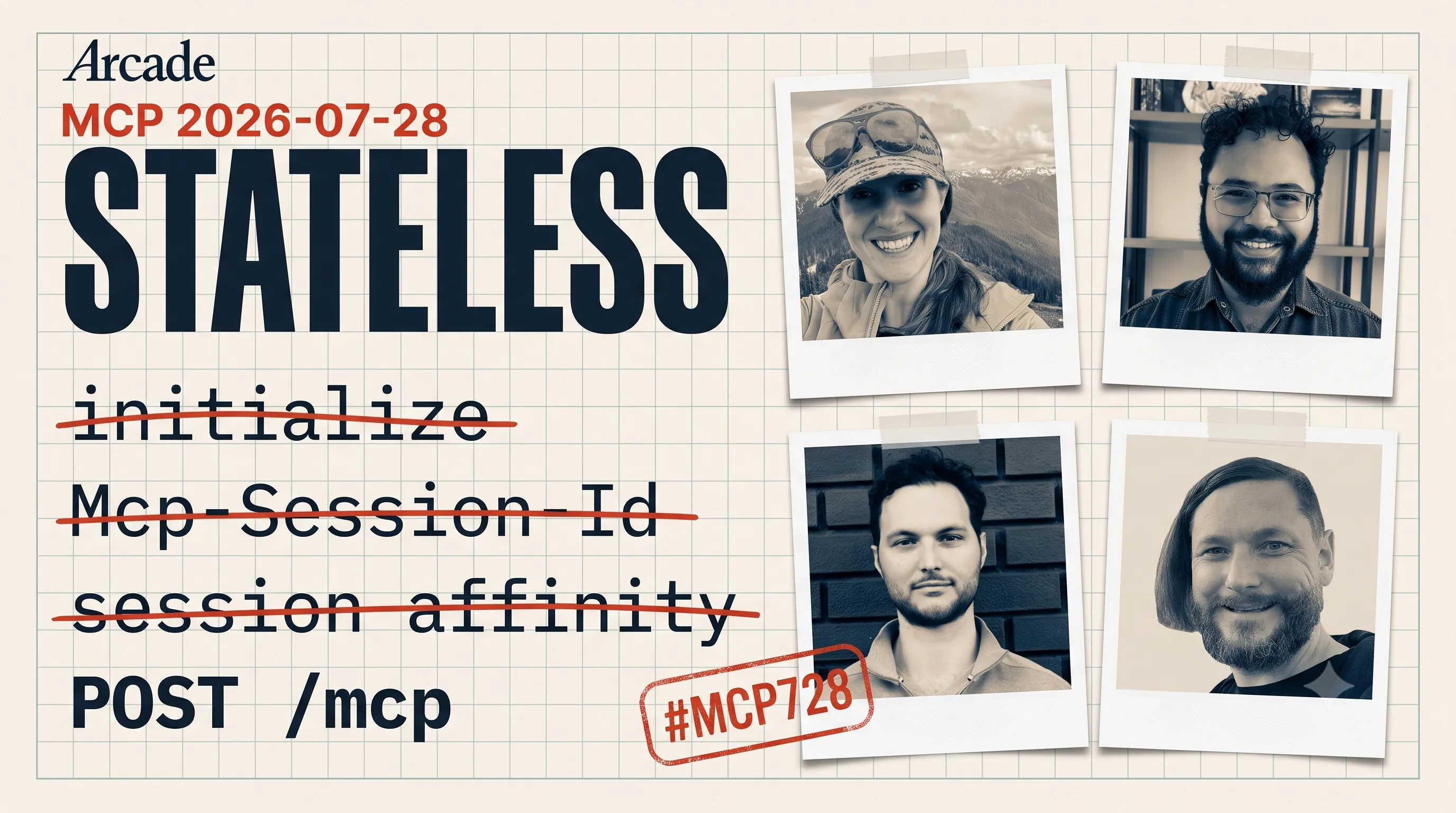



The new Model Context Protocol (MCP) release is the largest revision of the protocol since launch and the headlines are a stateless core, first-class extensions, and authorization hardening that lines MCP up with how OAuth and OpenID Connect get deployed.
For the enterprises shipping agents in production, that headline comes with work. A stateless rewrite, deprecated features, and a growing list of extensions all create churn, and someone has to absorb it. The protocol won’t do it for you. Something in your stack has to.
We’ve published over 20 articles breaking down the ins and outs of the release with Arcade.dev intentionally in the backseat because this moment is about more than any one company, but here I want to be direct about where we fit.
Arcade Speaks Both Versions of the Protocol
Arcade is the actions runtime for enterprise AI agents, the layer your agent calls through when it needs to do something in a real system. It spoke the 2026-07-28 shape on day one, and it still speaks the older versions that use session IDs. So with Arcade, you move your servers and clients to the new stateless protocol on your own schedule instead of coordinating a single cutover.
That matters at scale. Ten clients with different capabilities talking to ten servers with different capabilities is a big matrix, and extensions make it bigger. Arcade sits between clients and servers as an MCP gateway and resolves what each side actually supports. When an extension ships a breaking change and com.company/memory becomes memory-v2, that’s one update in Arcade’s control plane, not a change rolled out across every server-client pair. The matrix collapses to a single point you control.
Always On: authorization, security, and governance
The deeper reason the runtime layer matters is the controls you can’t afford to fragment — authorization, security policy, and governance — don’t live in the protocol at all with Arcade. They live in the runtime, on every action, no matter which protocol version a client speaks.
Arcade brokers the OAuth flow and holds tokens in an encrypted, per-user vault, injecting the credential only at execution and never handing it to the model or the client. A post-prompt authorization check is scoped to the intersection of what the user may do and what the agent may do, evaluated per action rather than granted through a service account or a shared token. And a pre- or post-hook, say one that strips PII, runs every time, regardless of the client on the other end. The transport churns underneath while your controls hold steady.
We can promise that because we first built this runtime independently from MCP, so our governance was never coupled to a single protocol. Enforcement lives at the boundary where an agent acts, in code rather than a wire format, so the same authorization, scoping, and audit model applies over MCP today and agent-to-agent (A2A) tomorrow.
The fragmentation is temporary, and the ecosystem will settle. Until it does, the teams deploying agents shouldn’t have to babysit a compatibility matrix at 2 a.m. That’s the job we signed up for.
See the Arcade docs to get started.
From explainers to step-by-step instructions, Arcade is your guide to the largest revision to the MCP spec since launch. Click here for all of our coverage.