Nate Barbettini

Nate Barbettini

Founding Engineer

Nate has built AI products, is a recognized expert in authentication, led engineering teams, and wrote the book on software development (literally). As CTO of Cobbler, he built an AI agent stack from scratch, facing the very challenges Arcade now solves. His OAuth 2.0 training is the most watched in the world. At Okta and Stormpath, Nate built authentication APIs that developers enjoyed. With his AI experience, deep security know-how, and instinct for dev-friendly design, Nate knows exactly what developers need and what they’ll like using.


Articles (11)

All authors
Bring Any Third-Party MCP Server to Arcade.dev and Govern It Like Your Own
MCP

Bring Any Third-Party MCP Server to Arcade.dev and Govern It Like Your Own

Register any remote MCP server with Arcade.dev — from a vendor, a partner, or your own team — and govern its tools from one control plane, with every user authenticating as themselves.

An Interview With the MCP Maintainers Who Decided to Break the Protocol
THOUGHT LEADERSHIP

An Interview With the MCP Maintainers Who Decided to Break the Protocol

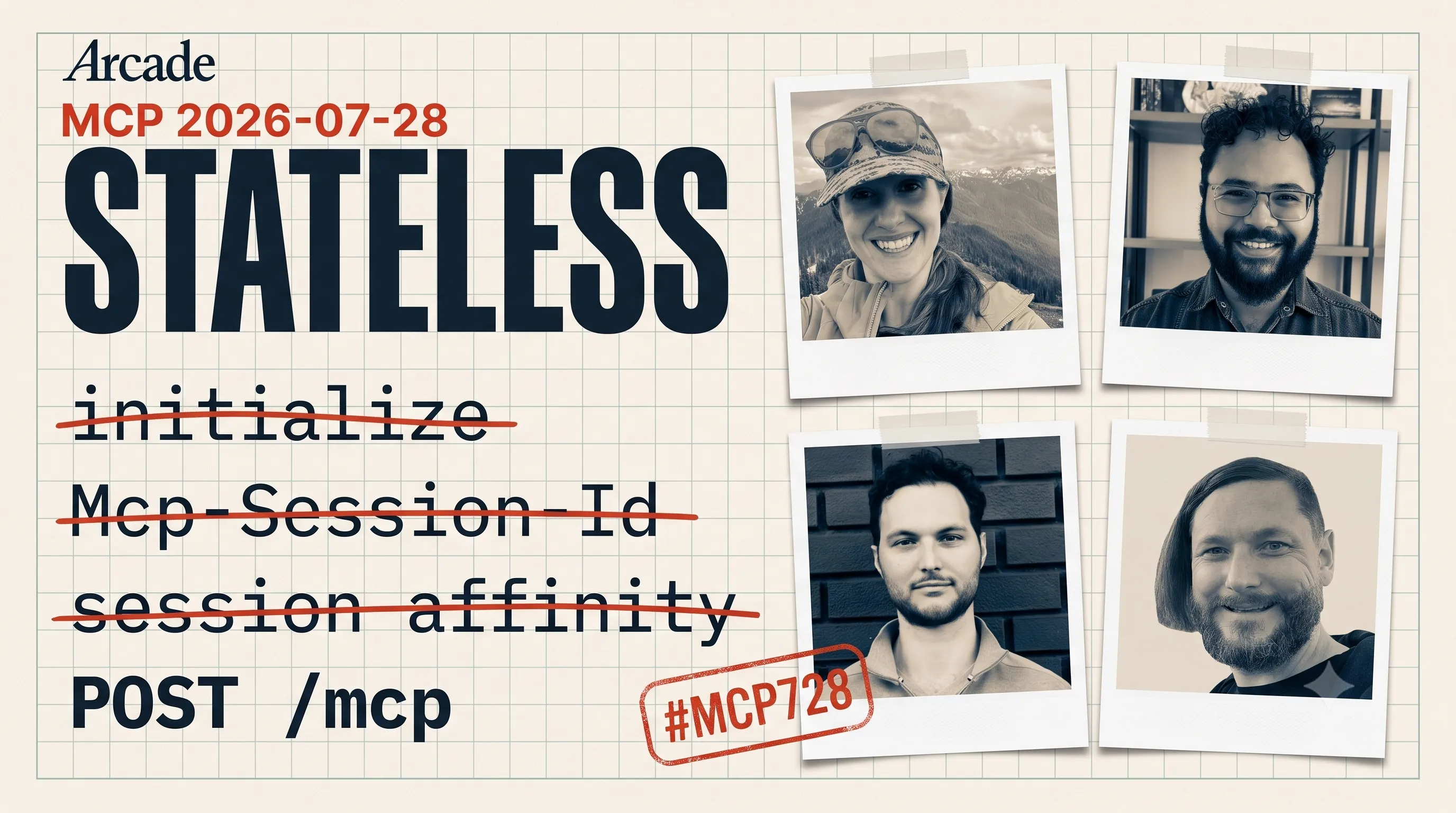
The MCP 2026-07-28 release drops the initialize handshake and the session ID for remote servers. Arcade.dev's Nate Barbettini and Mateo Torres sit down with core maintainers Caitie McCaffrey (Microsoft) and Sam Morrow (GitHub) on why they took a breaking change this size — and what it costs to adopt.

MCP '26 Migration Checklist. What to Do Before Your Server Meets the New Protocol post icon Rays decoration
THOUGHT LEADERSHIP

MCP '26 Migration Checklist. What to Do Before Your Server Meets the New Protocol

Nothing breaks on day zero, but if you build or operate MCP servers, the July 28 switch to the stateless protocol is real work. Nate Barbettini's seven-step migration checklist — from weird day-zero traffic to the satisfying cleanup — plus where Arcade.dev absorbs the messy middle.

Zero Consent Screens: An EMA x MCP Conversation with Aaron Parecki and Paul Carleton
THOUGHT LEADERSHIP

Zero Consent Screens: An EMA x MCP Conversation with Aaron Parecki and Paul Carleton

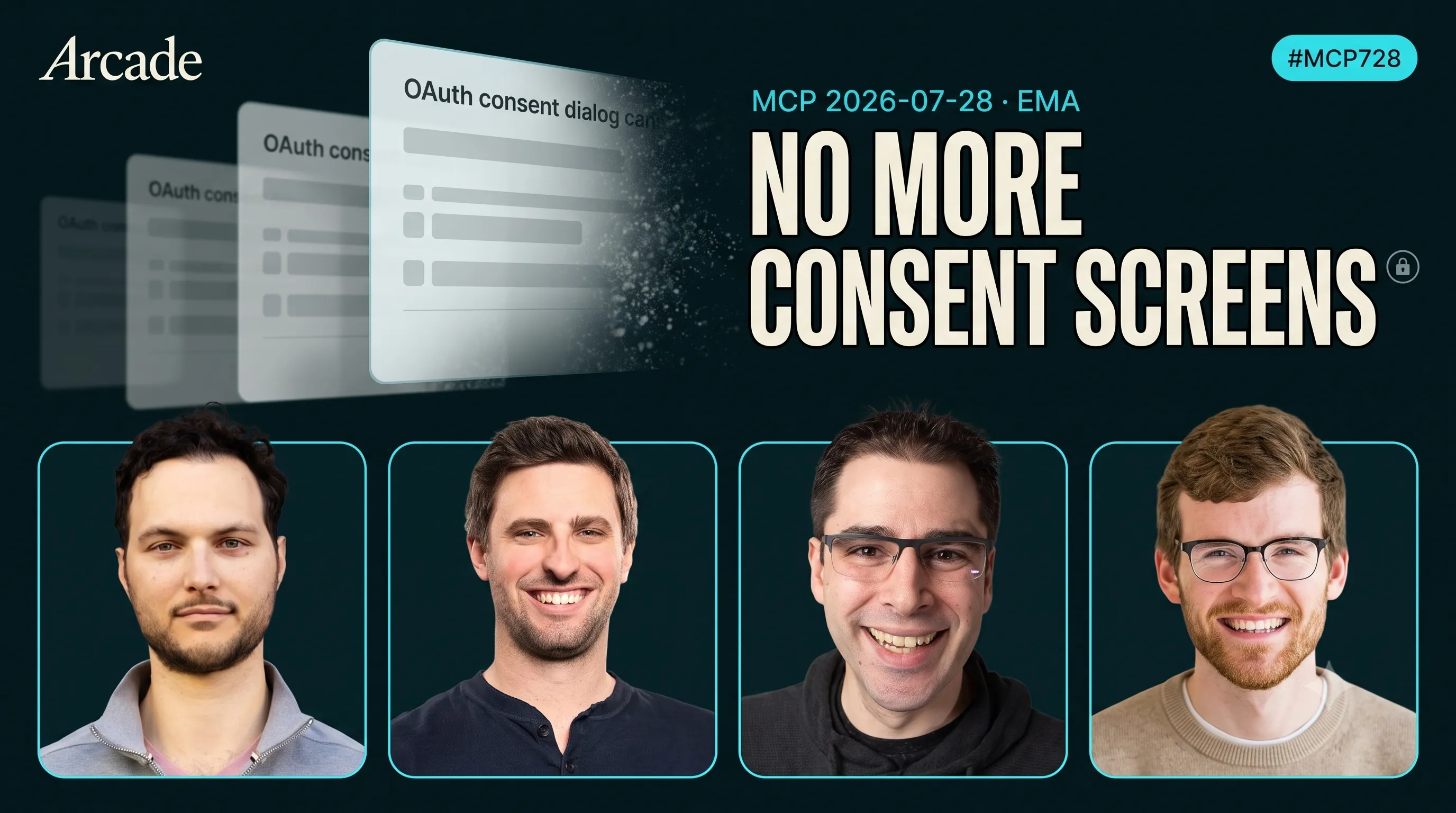
Enterprise-Managed Authorization (EMA) lets an employee sign into an MCP client with company SSO and find every MCP server already connected — no consent screens, no API keys. Arcade.dev's Nate Barbettini and Wils Dawson sit down with Okta's Aaron Parecki and Anthropic's Paul Carleton to unpack how it works.

MCP Is Going Stateless. Here's What That Means post icon Rays decoration
THOUGHT LEADERSHIP

MCP Is Going Stateless. Here's What That Means

Building an MCP server on your laptop is easy; running one for 10,000 employees isn't. The 2026 MCP release reworks the protocol from stateful to stateless, dropping session IDs. Here's what's changing, why it breaks things, and the payoff.

How Arcade.dev Proactively Addressed The First Major Identity Vulnerability in Agentic AI

How Arcade.dev Proactively Addressed The First Major Identity Vulnerability in Agentic AI

While building an AI demo has become trivially easy, production-grade deployments in enterprises have been stifled by performance issues, costs, and security vulnerabilities that their teams have been warning about. Today, we're addressing one of those vulnerabilities head-on. A new class of identity attack Security researchers at The Chinese University of Hong Kong recently identified new variants of COAT (Cross-app OAuth Account Takeover), an identity phishing attack targeting agentic AI a

Let's talk about LLM tools: simple additions with massive results post icon Rays decoration
THOUGHT LEADERSHIP

Let's talk about LLM tools: simple additions with massive results

It’s popular to test Large Language Models (LLMs) by asking them to solve difficult puzzles, like multiplying huge numbers. These tests are interesting research benchmarks, but they can miss something important: real-world usefulness. When was the last time you asked a coworker to multiply a 20-digit number in their head, without a calculator? Real-world usefulness is not always well-represented by artificial benchmarks. Throughout history, humans have invented tools to boost their abilities: c

MCP Grows Up: The Spec That Makes AI Agents Real post icon Rays decoration

MCP Grows Up: The Spec That Makes AI Agents Real

You tell your AI agent: “Send that report to my manager.” It drafts the perfect message — and then stops. The problem isn’t intelligence; it’s identity. It can’t press “send,” because your email — like every good enterprise system — lives behind an auth wall. That’s the invisible barrier keeping AI from doing real work: agents can’t safely act on behalf of their users. That small roadblock points to a much bigger one. AI agents can reason, plan, and communicate — but they’ve been locked out

Building MCP Together: Arcade's Contribution to Secure Agent Auth post icon Rays decoration
MCP

Building MCP Together: Arcade's Contribution to Secure Agent Auth

See URL Mode Elicitation in Action → Watch our engineer Will Dawson walk through the new MCP proposal that's solving one of the biggest security gaps in AI tool-calling. In 15 minutes, you'll see how agents can finally handle OAuth flows, payment confirmations, and API keys without exposing sensitive data to the LLM. Watch the technical walkthrough → Your AI agent needs to search Gmail for that weekly report. You've built an MCP server, the tool definition, everything's wired up perfectly. One

Why MCP Is Stuck on Your Laptop (And How to Fix It)
MCP

Why MCP Is Stuck on Your Laptop (And How to Fix It)

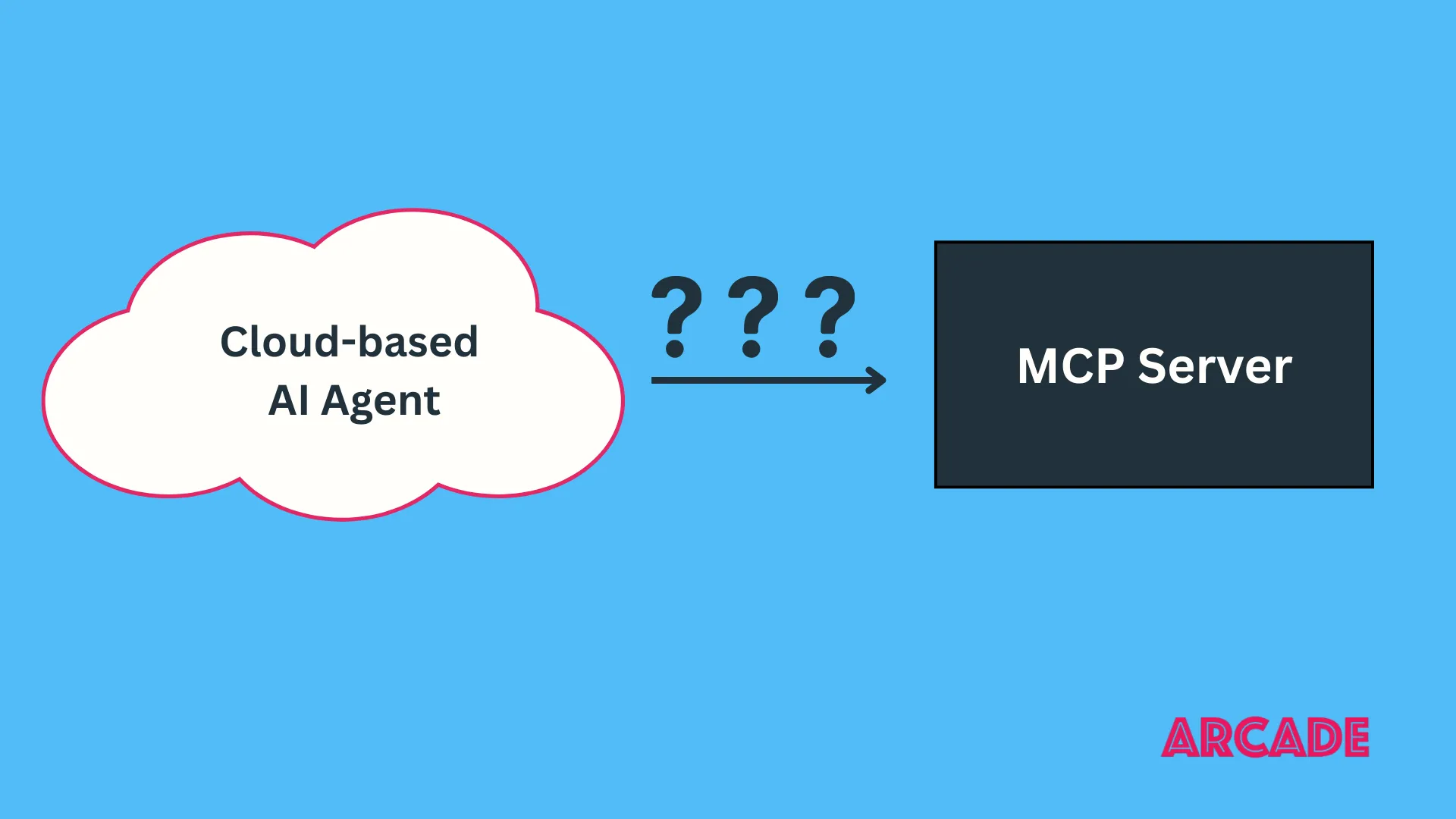
Model Context Protocol (MCP) is generating a lot of excitement right now. It’s a simple, elegant spec that makes it easy to expose functionality and contextual data to AI models in a structured way. Want to create GitHub issues or email stakeholders just by asking your code editor? It works great—locally. MCP enables some cool use cases on your local machine today. But what if you’re building something cloud-hosted? What if your agent runs in a browser, on a server, or in a cloud function? Th

Announcing: Native support for MCP Servers
MCP

Announcing: Native support for MCP Servers

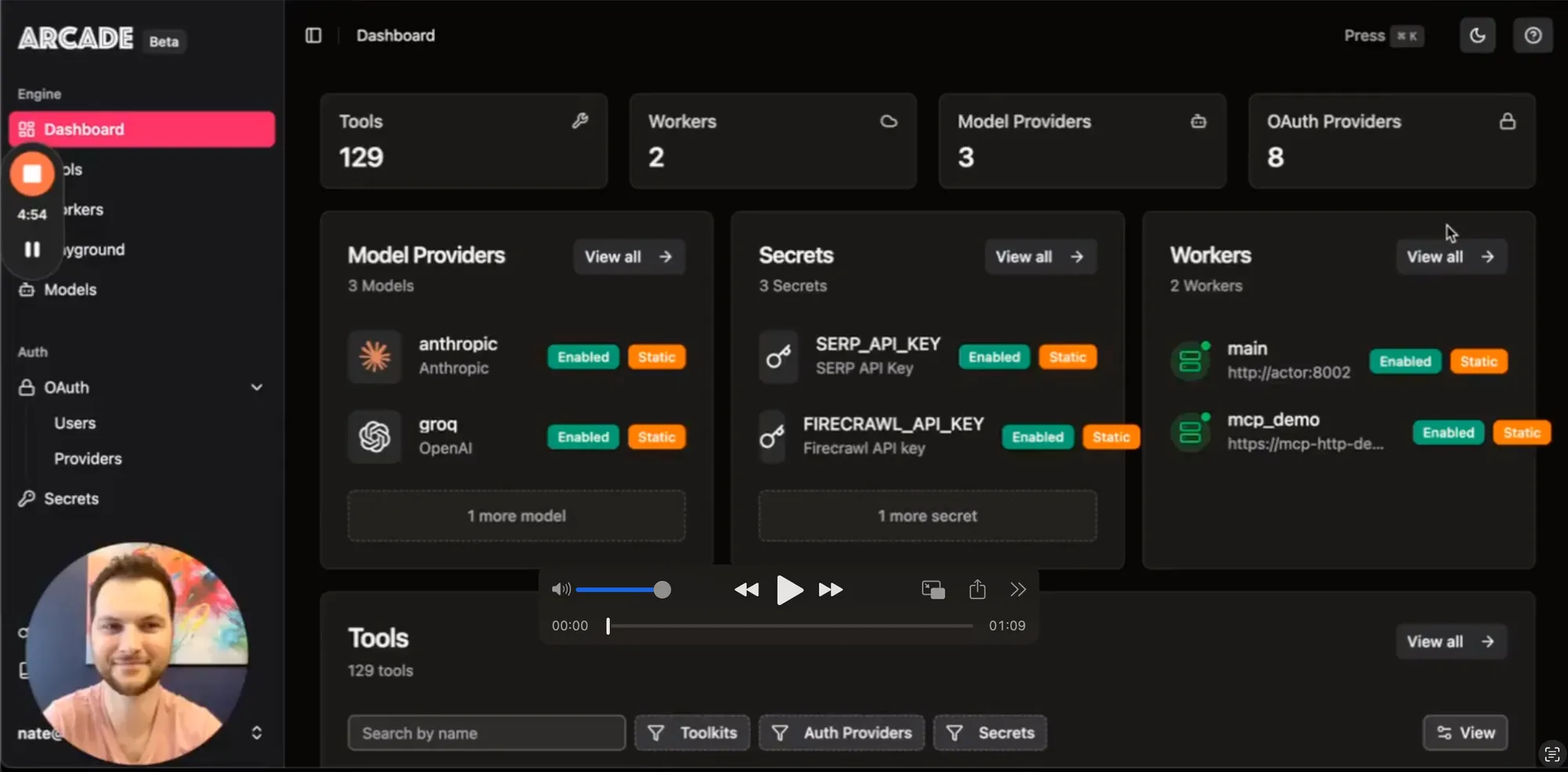
What is MCP? Model Context Protocol (MCP) is having a moment, and for good reason: it's an open, standard way to connect tools and agents. At Arcade, we're thrilled to see the industry adopting an open standard for tool calling, because it means even more options and flexibility for devs building agents. Easily connect to any MCP Server with Arcade Today, we're excited to release native support for MCP servers in Arcade! Arcade can now connect to any MCP server supporting the new streamable

Blog CTA Icon

Get early access to Arcade, and start building now.