



Arcade.dev has been selected to the 2026 Enterprise Tech 30 award list!
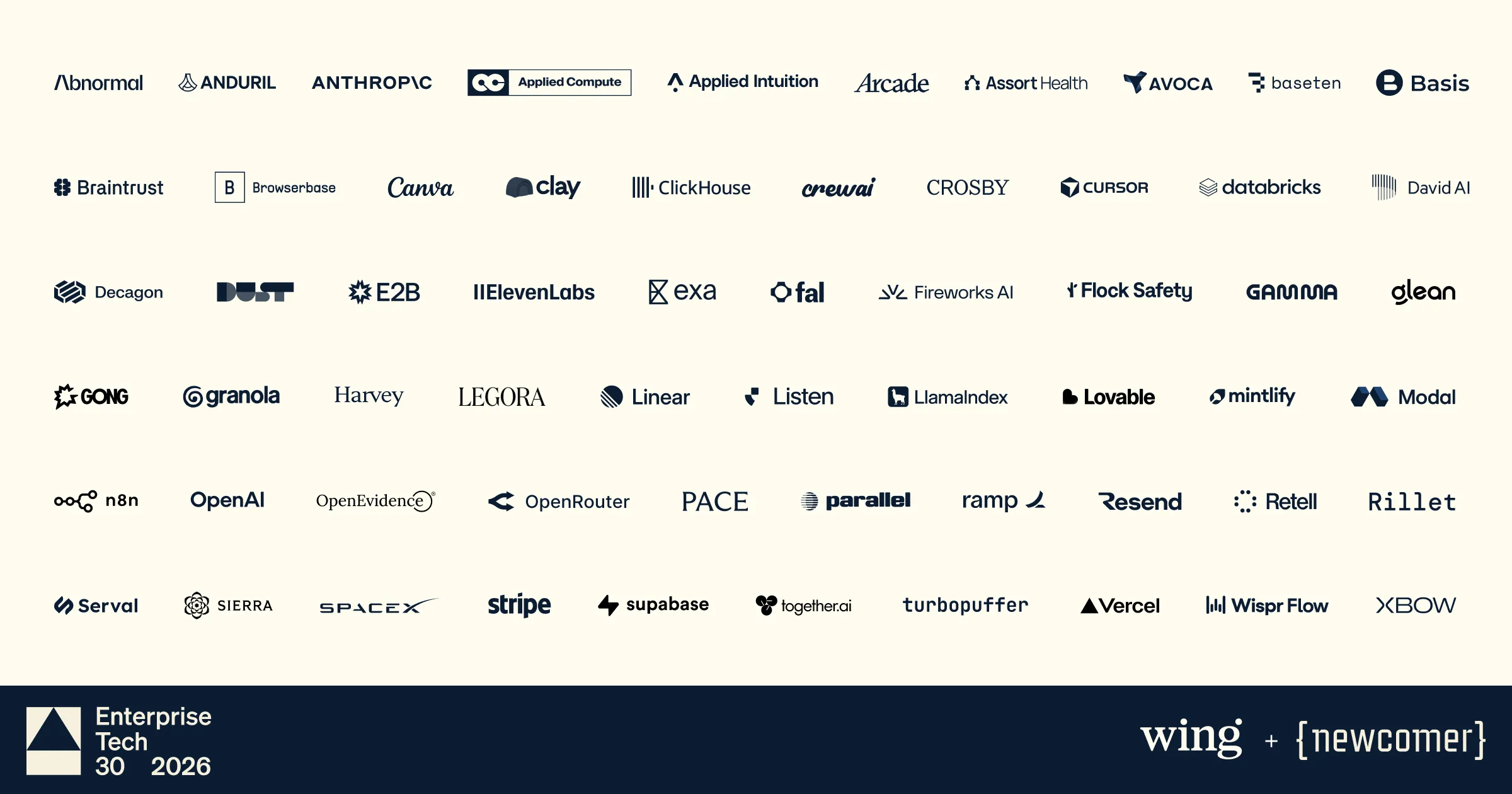
Presented by Wing Venture Capital, the list recognizes the most promising private companies across the full enterprise technology stack, based on research and input from over 100 top VCs and Eric Newcomer of Newcomer Media. Arcade joins some of the biggest names in AI—Anthropic, OpenAI, Stripe, and Cursor—as one of the leaders pushing enterprise AI forward.
Here’s a look at how we got here:
2024: From Demo to Production
We started Arcade because we kept running into the same wall. Everyone wanted agents that could actually take actions — send emails, update CRMs, book meetings — but nobody had figured out how to make that safe. The biggest blocker was authorization at runtime, across multiple users, with full audit trails. That’s where agent demos were dying before reaching production. So we built the solution.
2025: MCP Changes Everything
When MCP took off, we were ready. We shipped the first MCP runtime, open-sourced our MCP Framework, and built 8,000+ production-grade tools that actually work—not vibe-coded API wrappers. We co-authored the URL Elicitation spec with Anthropic to standardize how agents handle OAuth and joined the Linux Foundation’s Agentic AI Foundation as a founding Gold Member. And we started working with some of the world’s largest enterprises, including a top 5 financial institution, to put entire fleets of agents into production.
2026: Agents Are the Center of the Universe
The shift happened faster than most expected. With the rise of Claude Code and OpenClaw, long-running, tool-calling agents stopped being a curiosity and became the default way engineering teams ship software. Agents aren’t running in sandboxes anymore; they’re taking action across platforms on behalf of real users, at scale, without a human in the loop for every step.
And that’s exactly where the hardest problems in enterprise AI are now concentrated. The demo era asked “can the agent do it?” The production era is asking something harder: What did the agent do, on behalf of which user, in which system? Trust, reliability, and governance have become the defining challenges because agentic workflows are succeeding. When a single agent can act across dozens of systems on behalf of thousands of users simultaneously, the blast radius of a misconfiguration, a bad tool call, or a bad authorization decision is enormous. That’s the exact problem Arcade was built for from day one.
The market has caught up to the problem we saw coming. The center of gravity in enterprise AI has shifted to agents, and Arcade is how they make it to production.
FAQ
What is the Enterprise Tech 30 list?
The Enterprise Tech 30 is an annual list presented by Wing Venture Capital that recognizes the most promising private companies in enterprise technology. The 2026 list was determined through research and input from over 100 top venture capitalists and Newcomer Media. It highlights industry leaders, including Anthropic, OpenAI, Stripe, and Arcade.
Why was Arcade recognized on the 2026 Enterprise Tech 30 list?
Arcade earned a spot by providing the infrastructure that lets engineering teams deploy AI agents into enterprise production. The company solved major industry blockers around runtime authorization, governance, audit trails, and multi-user policy enforcement for agentic workflows.
What does Arcade do for enterprise AI agents?
Arcade is the MCP runtime that governs every AI agent tool call. It enforces the access and compliance policies your organization has already defined in its IDP, sales, and security tools at the moment of the call. The runtime handles multi-user authorization, audit logs, and reliable tool execution, enabling enterprise teams to scale long-running agents without a human in the loop at every step.
How does Arcade support the Model Context Protocol (MCP)?
Arcade ships the first production MCP runtime and an open-source MCP Framework. The company maintains over 8,000 production-grade tools that integrate with the protocol. Arcade also co-authored the URL Elicitation specification with Anthropic to standardize how MCP agents handle OAuth flows.
Why do AI agent demos fail to reach production in enterprise environments?
AI agent workflows fail to reach production because they lack governance, multi-user authorization, and audit trails. When an AI agent takes action across dozens of systems on behalf of thousands of users, the impact of one bad authorization decision is massive. Organizations rely on MCP runtimes like Arcade that handle governance natively to mitigate these risks at scale.
What is the URL Elicitation specification for AI agents?
The URL Elicitation specification is a technical standard co-authored by Arcade and Anthropic that defines how AI agents handle OAuth authentication. The spec lets agents using the Model Context Protocol authenticate real users and request access to connected software. It is the foundation for standardizing identity and access management across enterprise AI applications.